

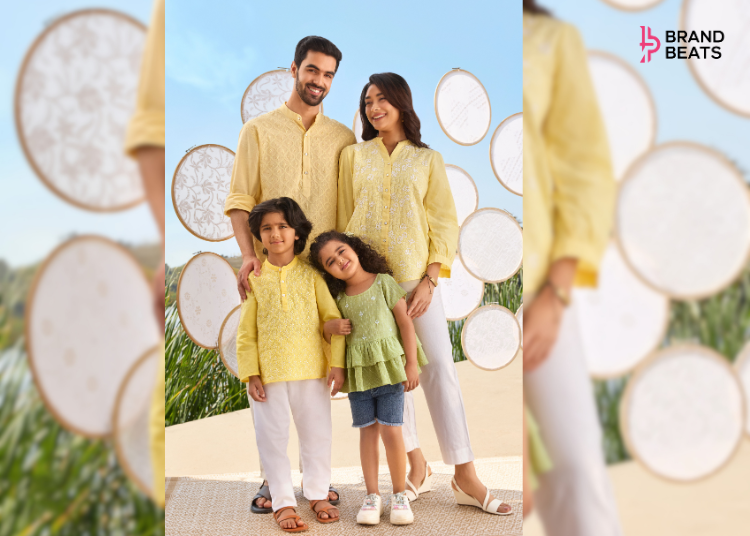
Fabindia has unveiled the second verse of its Spring 2026 campaign, ‘The Song of Spring’, spotlighting a new Chikankari collection that blends centuries-old craftsmanship with contemporary design sensibilities. The collection spans diverse categories, offering Ethnic and Western styles for men, women and children.
Reimagining the traditional Lucknowi embroidery for the modern wardrobe, the Spring 2026 line moves beyond conventional pastels to introduce a vibrant palette of plum, berry and fuchsia tones across cotton, crepe and yarn-dyed fabrics. The silhouettes range from versatile co-ord sets and structured vests to fluid resort dresses and saris, presenting what the brand describes as a refined balance between heritage artistry and sharp contemporary style.
A standout feature of the collection is its monochrome series, where high-contrast black-and-white embroidery reinterprets Chikankari into a bold, modern aesthetic statement. By combining traditional needlework with strong visual contrasts and updated cuts, the range positions the craft within a more experimental and fashion-forward framework.
Alongside the apparel launch, Fabindia has released a campaign film that places the spotlight on the artisans behind the craft. Emphasising the human element of Chikankari, the film takes viewers inside artisan clusters to highlight the patience and precision involved in each stitch.
Extending the Spring narrative to the entire family, the collection includes menswear featuring long and short kurtas, shirts with intricate yoke embroidery and ombre finishes, as well as a vibrant kidswear line. The children’s range includes all-over embroidered kurtas and checkered shirts in a fresh palette of sun-washed yellows, tender pinks and breezy blues.
Link to the campaign:
Commenting on the launch, a Fabindia spokesperson said: “Behind every thread is a heartbeat; behind every pattern, a lifetime of devotion. To provide deeper context to the craftsmanship, we have released a film highlighting the master craftspeople within the artisan clusters. It offers an intimate lens into our cluster communities, going behind the stitches to reveal the patience and precision that define Chikankari. It is a tribute to the human element, the master craftspeople who transform a rhythmic needle-pull into a cultural legacy.”