
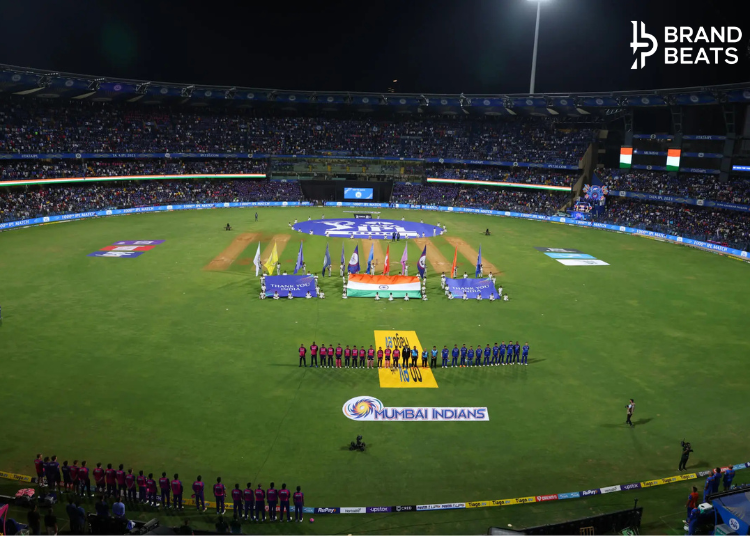
In 2008, the Indian Premier League didn’t look like a serious media platform. It looked like a spectacle stitched together for television city-based teams, film stars in the stands, player auctions turned into prime-time drama. To many, it felt loud, chaotic, almost like cricket’s version of a reality show. Entertaining, definitely. Enduring, uncertain. What most people didn’t notice then was the structure quietly taking shape beneath all that noise, a tightly controlled ecosystem, limited teams, centralised rights, and a format designed not just for sport, but for sustained attention.
Over time, that spectacle hardened into something far more powerful. The IPL stopped being just a tournament and became a concentrated burst of national attention, a property that doesn’t just attract viewers but absorbs brands, budgets, and cultural relevance into a single, high-intensity window. It is no longer just watched; it is planned around, marketed through, and built into the business models of platforms and advertisers alike.
But in becoming this massive attention engine, something else has happened. The very scale that makes the IPL irresistible has also made it overwhelming. What was once a stage where a few brands could stand out has turned into a crowded marketplace where everyone shows up, and almost no one leaves a mark. The evolution is undeniable, but so is the irony. The IPL has mastered the art of capturing attention. It just doesn’t guarantee who gets to keep it.
The illusion of impact
On paper, IPL advertising works exactly the way it is supposed to. Brands report spikes in awareness, certain categories see clear sales movement, and among highly engaged viewers, a significant chunk claims they’ve been influenced by something they saw during a match.
According to the eDART-IPL 2025 report by CrispInsight and Kadence campaigns during the tournament can drive higher brand awareness and even measurable sales uplift, espe cially when executed across platforms. Among highly engaged “superfans,” nearly 77% report being influenced by at least one brand. These numbers justify the spend. They validate the hype, but they also hide something critical because influence is not evenly distributed and recall is not guaranteed.
In fact, category-level data reveals how fragile memory really is while some categories like fantasy sports recall as high as 48%, others drop to single digits, sometimes as low as 3%.
The result is a brutal asymmetry: the same platform, the same audience, the same exposure but completely different memory outcomes. Some brands ride the moment and stay with you long after the match ends. Most are forgotten before the next over begins.
Too much visibility, too little distinction
The real problem with IPL advertising is not clutter, it is indistinguishable clutter and the easiest way to see it is to ask yourself a simple question after a match, which ads do you actually remember? Not the ones you saw, the ones you can recall without effort. Because what plays out across those ad breaks is a loop of repetition dressed as variety.
For example, one ad shows a cricketer casually giving “smart investing” tips, another has a celebrity simplifying trading like it’s a game, a third wraps risk in humour but strips away the faces, and the scripts are almost interchangeable. You remember the celebrity, maybe the joke but not the brand behind it.
Even high-spend campaigns with big stars like Ranbir Kapoor in one ad, Rohit Sharma in another, MS Dhoni in five different places blur because the storytelling doesn’t change with the face. The celebrity becomes the constant, the brand becomes replaceable.
So while the screen is full, the mind remains largely empty. Because when every brand follows the same playbook, same faces, same humour, same structure, the audience stops decoding the differences and when differences disappear, so does memory.
The CPM vs Recall gap
What makes IPL advertising uniquely tricky and expensive is that it is not competing with other ads, it is competing with the IPL itself. And that has always been the real benchmark. The campaigns people still remember didn’t just “run during IPL,” they matched or even elevated the entertainment of the tournament.
In the early Sony era, when IPL was positioned like a carnival, the ZooZoos became cultural icons without relying on celebrities or heavy messaging. Virgin Mobile’s “Indian Panga League” didn’t interrupt the experience; it participated in it. Even Amazon’s “Chonkpur Cheetahs” built a fictional world that audiences followed alongside the matches.
Then came the Star Sports phase, where storytelling leaned into cricket itself. Campaigns like “Mauka Mauka” or “Game Banayega Name” didn’t feel like ads; they felt like extensions of the rivalries, emotions, and narratives already playing out on the field. Today, in the JioHotstar era, the platform itself has entered the story. The medium is no longer just a carrier; it is part of the competition.
Across all these phases, one pattern is clear: the ads that worked didn’t just use IPL for reach, they rewarded the viewer. They gave people something worth remembering.
And that is exactly where most brands struggle today. IPL is no longer a captive viewing environment. The audience is watching the match, scrolling Instagram, replying to WhatsApp, and switching screens all at once. Your ad plays. It is seen. It may even be processed. But within seconds, it is followed by another ad often with the same tone, same structure, and sometimes even the same celebrity. The attention you bought is real, but it is fleeting. More importantly, it is fragile.
The impressions were delivered. The recall was not.
This is the CPM vs recall gap. Brands are optimising for how many people saw them, not for how many people kept them. And in an environment like IPL where repetition is high and differentiation is low, memory does not scale with spend. It filters.
Which is why, despite the scale, most brands are stuck in the same loop. They are successfully buying attention in the moment but failing to hold it in memory.
Playing Safe is the Fastest Way to Be Forgotten
What makes this even more frustrating is that most brands already know the problem yet they keep choosing the safer route.
IPL is an expensive stage, and expensive stages make brands risk-averse. When you’re spending crores on a few seconds, the instinct is to avoid failure. So brands default to what feels “safe”: a popular cricketer, a familiar format, a joke that won’t offend, a script that has worked before. On paper, it looks like a sensible decision.
But in reality, this safety creates sameness. The cost of playing safe, then, is not just creative mediocrity, It is invisibility and this is exactly where most IPL advertising quietly fails.
The IPL has solved the hardest problem in advertising, it guarantees attention. What it doesn’t guarantee is what happens after. Because in a space where everything is loud and fast, and attention is not scarce anymore, distinction is and that is where most brands are quietly failing. Not because they didn’t show up, not because they didn’t spend enough, but because they chose to blend in on the biggest stage possible.
The uncomfortable truth is IPL is not exposing weak media plans, it is exposing weak ideas.
You can buy reach. You can buy frequency. You can even buy the biggest celebrities in the country but you cannot buy what actually builds brands ‘memory’. IPL will continue to do what it does best deliver massive attention to everyone, and lasting impact to maybe only a few.