

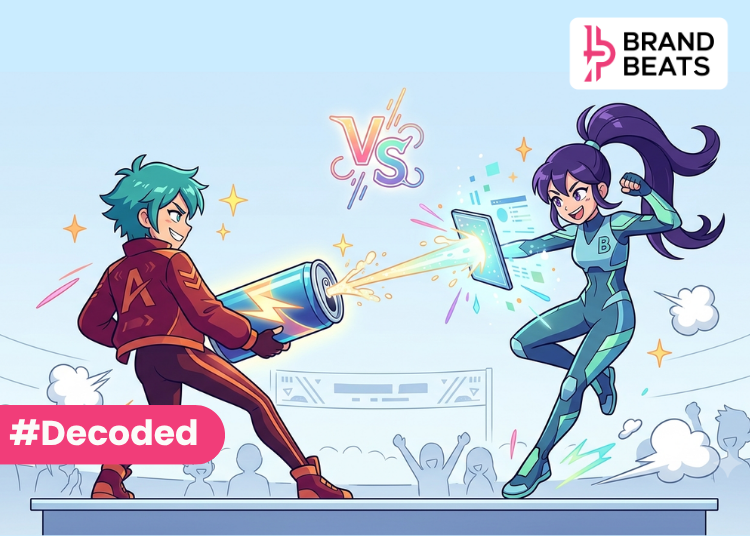
Remember when Samsung mentioned Apple, Pepsi took a playful swing at Coke, and suddenly everyone had something to say?
That is the fun part about brand rivalries: the audience already knows the drama.
You don’t need to introduce the characters. You don’t need three paragraphs explaining who the competitor is or why these two brands keep poking each other. The audience already knows the history, the tension and, most importantly, what usually happens next.
One brand throws a punch.
The other comes back with a punchline.
The internet picks a side.
And suddenly, an advertisement has become entertainment.
This is where the Rivalry Reference Effect comes in.
Comparative advertising tells us what the brand is doing mentioning or comparing itself with a competitor. The Rivalry Reference Effect explains why the reference can be so engaging.
The competitor is no longer just a competitor.
They become a character in the story.
And once that happens, a product launch can become a comeback, a tweet can become a punchline, and a simple brand response can feel like the latest episode of a soap opera nobody remembers subscribing to.
Your Brain Already Knows the Characters
Imagine two unknown smartphone brands taking shots at each other online. Maybe you notice it. Maybe you scroll past.
Now imagine Samsung taking a swipe at Apple. Suddenly, there is a story.
You already know the characters. You know they compete for the same consumers. You know the arguments they repeatedly have cameras, displays, design, AI, ecosystems, charging, foldables. So the brand does not have to spend half the ad explaining the setup.
The audience arrives with the backstory already loaded.
That is where the psychology gets interesting.
Research on rival references suggests that consumers can find messages involving a true rival more engaging because the reference feels ‘story embedded’ connected to an existing narrative instead of being a random standalone advertisement.
In other words, Samsung does not have to create a story from zero. Apple has already handed it a plot.
Apple Launches iPhone Duo. Samsung Brings the Popcorn.
The latest Apple-Samsung exchange is almost a textbook demonstration.
Apple unveiled the iPhone Duo, its first foldable iPhone, on September 9, 2026. The device opens into a 7.6-inch inner display and is scheduled to go on sale in India on October 23.
Samsung, which already has an established foldable lineup, immediately joined the conversation.
Its social posts described the Duo as a ‘Sims sequel’ and joked about Apple ‘reheating our leftovers,’ while another response played on the idea of “so far, so same.”
The joke worked because Samsung was not simply saying: “We have foldables too.”
It was saying: ‘Oh, you finally joined us?’
That tiny shift changes everything. A normal competitor comparison gives you information: Brand A has feature X; Brand B has feature X.
A rivalry reference gives you entertainment: Brand A just entered the territory where Brand B has been playing for years. And suddenly, a product launch becomes a social-media episode.
The audience is no longer just evaluating phones. It is watching the rivalry unfold.
But Samsung Did Something Even Smarter: It Turned Switching Into Relationship Drama
The rivalry does not always have to be a direct ‘our product beats yours’ attack..
Coca-Cola vs Pepsi: The Original Brand Soap Opera
Long before brands were fighting in comment sections, Coca-Cola and Pepsi were already proving that rivalry could become entertainment.
The ‘cola wars’ turned two familiar category choices into recurring advertising characters. Each brand could reference the other because consumers already understood the tension. Research and marketing literature around comparative advertising have repeatedly examined how rival references can capture attention and make advertising more involving.
That familiarity created enormous creative freedom. A Pepsi ad could joke about Coke.
Coke could respond to Pepsi.
And audiences could instantly understand the joke without needing a history lesson.
That is the hidden advantage of a recognised rival: the competitor becomes part of your brand’s creative vocabulary.
The same basic mechanism has appeared in rivalries such as Apple versus Microsoft and Apple versus Samsung. Once two brands accumulate enough history, every new exchange carries the memory of previous ones.
It starts behaving less like advertising and more like a television series.
Except the brands are writing the episodes in real time.
The Trick Is Not to Attack a Competitor. It Is to Create the Next Episode.
This is where the Rivalry Reference Effect becomes genuinely useful for marketers. The objective is not simply to mention a competitor.
It works best when the rival is recognisable, culturally relevant and already associated with a meaningful conflict or contrast. Research specifically distinguishes references to true rivals from generic competitor references, finding that the rivalry context can make the message feel more narratively connected.
The formula is almost ridiculously simple:
Rival appears → old story is remembered → new message becomes the next chapter → curiosity increases → people react, share or take sides.
And there is another important detail: the best rivalry marketing usually has a wink.
Samsung calling the iPhone Duo “reheated leftovers” works because it is cheeky. Pepsi teasing Coke works because the audience understands the game. The brands are not just exchanging claims; they are performing a relationship.
That is why rivalry can make advertising feel strangely human. There is a protagonist, a challenger, an inside joke, a comeback and occasionally a plot twist.
The smartest brands do not simply ask: ‘How can we beat our competitor?’
They ask: ‘What happens next in the story?’
And once consumers start waiting for the answer, the rivalry itself becomes content.