

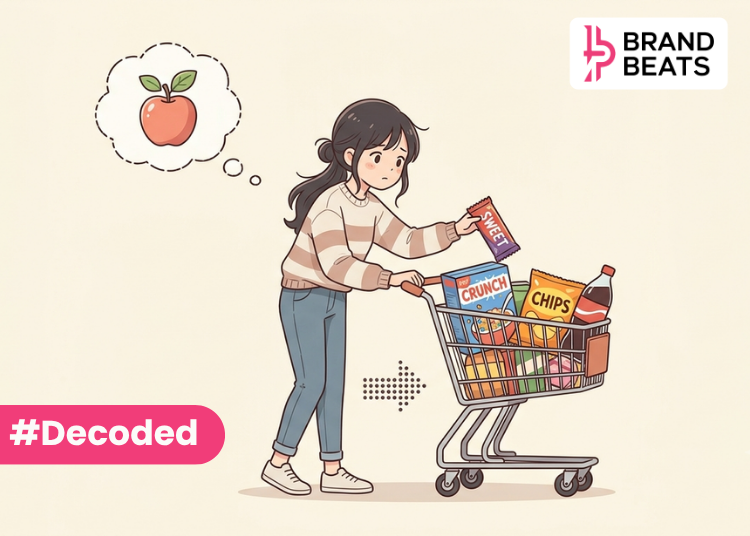

A consumer says, ‘I want to eat healthy.’ Then orders fries.
They say, ‘I should save money.’ Then add the premium version to cart because it comes with free shipping.
They care about sustainability, want to reduce plastic, support local businesses and buy more consciously. But when the actual buying moment arrives, convenience, price, habit or sheer temptation can suddenly take the driving seat.
This mismatch has a name: the Attitude–Behaviour Gap.
The attitude–behaviour gap is the disconnect between a consumer’s attitudes, values or intentions and their real-world behaviour.
In simple terms: ‘I believe this’ does not automatically mean ‘I will do this.’
A consumer may have a positive attitude towards sustainable products, for instance, but still choose a conventional option at the shelf. Not necessarily because their attitude is fake, but because behaviour is influenced by several other forces at the moment of decision.
Price can interfere. Convenience can interfere. Availability, habit, social influence and familiarity can interfere too.
That is why asking consumers what they want is not always enough to predict what they will buy.
Marketing often focuses heavily on attitudes because surveys make them easy to measure. Consumers can tell brands what they care about in a questionnaire. But purchase behaviour happens in a messier environment.
And that is where the gap appears.
Why Do Consumers Say One Thing And Do Another?
The first culprit is intention without action. People can genuinely intend to behave differently but fail to follow through. “I’ll start exercising tomorrow” is basically the attitude–behaviour gap wearing gym shoes.
The second is friction.
Consumers might want the sustainable, healthier or more responsible option, but if it costs more, takes longer to find or requires extra effort, the intention can collapse at checkout.
Then comes habit.
A consumer may intellectually prefer trying new brands, while repeatedly buying the same familiar product without thinking. Habit reduces the amount of decision-making required, which makes it incredibly powerful.
There is also context. Someone may say they prefer healthy snacks when discussing food choices in general. Put them at 11:30 p.m., hungry and scrolling through a food-delivery app, and the answer may suddenly become very different.
This is why consumer behaviour in marketing cannot be understood through stated preferences alone.
The question is not only, ‘What does the consumer believe?’
It is also, ‘What happens between the belief and the buying button?’
How Brands Can Use The Attitude–Behaviour Gap
The smartest use of the attitude–behaviour gap in marketing is not to lecture consumers about inconsistency. It is to understand what is blocking the behaviour they already claim to want.
One way is to remove friction.
When consumers support a behaviour but find it inconvenient, brands can make that behaviour easier. The less effort required, the smaller the gap becomes.
Another approach is to translate an abstract value into a visible action.
‘Be sustainable’ is vague. ‘Carry this bottle and refill it’ is an action.
Marketing becomes more effective when it turns a broad attitude into something specific and easy to perform. Brands can also use social proof.
If consumers believe something is becoming normal, acting on that belief feels easier. The message subtly shifts from ‘You should do this’ to ‘People like you already do this.’
There is another useful lever: defaults.
When the desired behaviour is already built into the consumer journey, they do not need to make an extra decision. Small design choices can therefore influence behaviour without changing the consumer’s underlying attitude.
How Brands Tap Into The Gap Between Intent And Action
Indian brands have plenty of opportunities to work with this psychology because consumer intentions often collide with convenience, familiarity and everyday habits.
The Whole Truth is a useful example in the food category.
Consumers increasingly say they want to understand what goes into packaged food, but reading every label carefully is unlikely to become a daily ritual.
By putting ingredient transparency at the centre of its communication and product positioning, the brand reduces the effort required to act on the consumer’s preference for “cleaner” information.
Zepto operates on another side of the gap: convenience.
A consumer may have every intention of planning purchases, but real life frequently produces the famous ‘I need this right now’ moment. Quick commerce does not necessarily change what people value; it makes acting on immediate needs dramatically easier.
boAt also benefits from the gap between aspirational attitudes and actual purchase behaviour.
Consumers may claim they care about premium technology and carefully considered purchases, but buying decisions are still heavily shaped by design, social visibility, promotions and ease of choice.
The brand’s mass-market positioning helps turn an intention to upgrade into a low-friction purchase.
The interesting part is that none of these behaviours needs to be completely irrational. Consumers can genuinely care about one thing and still do another.
A consumer is not a spreadsheet with perfectly aligned thoughts, intentions and actions. They are making decisions while hungry, busy, distracted, loyal to old habits and occasionally tempted by a discount that was absolutely not in the plan.
And brands that understand that messy middle often understand the consumer better than brands that only listen to what consumers say.