


For a long time, women’s hygiene in India has had a visibility problem. While personal care has become an established part of everyday consumption, conversations around menstrual and intimate hygiene have often remained limited to a handful of products, shaped by social taboos, misinformation and a lack of awareness. For brands operating in the category, the challenge has therefore extended beyond selling products. It has also meant convincing consumers that these are needs worth addressing in the first place.
For Pee Safe, that has been one of the defining parts of building the business. What began with a toilet-seat sanitiser has expanded into a wider women’s hygiene portfolio, spanning menstrual care, period panties, menstrual cups and other personal wellness products. The company now reaches close to 20 lakh women every month in India, with its products available across multiple distribution channels and international markets.
But the journey has involved more than adding products to a catalogue. It has required the brand to invest in education, challenge established perceptions around periods and make hygiene products easier to access and purchase.
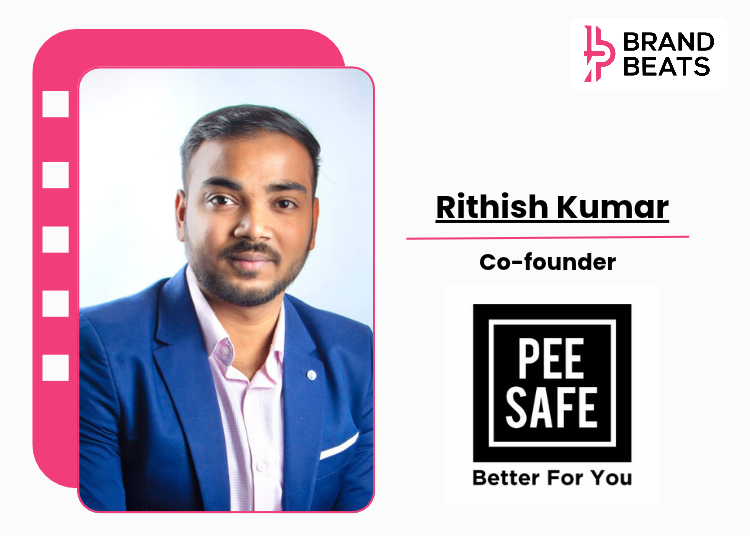
Speaking to Brand Beats, Rithish Kumar, Co-founder of Pee Safe, says awareness remains one of the biggest challenges in the category. “The biggest challenge was awareness. There was no awareness around women’s hygiene. Personal care was a priority, but hygiene was not, even though it is a basic essential need. We had to create a lot of awareness and invest a lot of money in making women and girls start taking it seriously.”
That challenge continues to influence how the company approaches its marketing, distribution and product strategy. As Pee Safe expands its portfolio and looks at the next phase of growth, the larger ambition is to become a health and hygiene platform for consumers rather than remain associated with a single category.
From A Personal Hygiene Concern To Pee Safe’s First Product
The origins of Pee Safe can be traced back to a personal experience involving its co-founders, Vikas and Srijana, during a road trip. What began as a routine journey turned into a health scare, eventually leading them to identify a gap in the market for a product that addressed toilet hygiene.
The co-founders had to abandon their trip and return to Delhi, where they were hospitalised. Doctors suggested that dehydration and the use of multiple toilets while travelling could have increased the risk of infection.
“As they were travelling, they were not drinking enough water and were using different toilets. Doctors said that these factors could have increased the risk of infection. But interestingly, they had not stopped at roadside eateries or dhabas. They had only visited good hotels and restaurants,” Kumar recalled.
It was this experience that led to the idea of a toilet-seat sanitiser.
“Even in a good hotel, somebody comes and cleans the toilet every hour, but nobody is ensuring that it is sanitised. You cannot practically see germs with your eyes,” he said.
The team found that women’s hygiene in India had seen relatively little product innovation. At the time, the sanitary pad category was largely driven by established companies with significant marketing and distribution capabilities
Pee Safe decided to take a different route. “We thought we would be innovation-led. We wanted to focus much more on the product, differentiate it and bring something new to the consumer. That is what set us apart,” Kumar said.
Product Innovation & The Numbers Behind Pee Safe’s Growth
Product innovation became a recurring part of Pee Safe’s expansion strategy. Rather than entering categories simply to increase the number of products on offer, the company looked at existing consumer needs and asked how it could address them differently.
One of its early launches was a longer-length panty liner, which Kumar says quickly found acceptance among consumers.
“The brand now sells around 40 lakh liners every month and describes itself as the country’s highest-selling liner brand. It subsequently introduced biodegradable and organic cotton sanitary pads and tampons, followed by menstrual cups.” Kumar added.
The portfolio has helped the company reach a wider consumer base. Its products currently reach close to 20 lakh women every month and nearly two crore women over the course of a year.
In India, Pee Safe has a distribution presence in around 150 cities. Its quick-commerce reach extends to approximately 350 cities, while its e-commerce operations cover nearly 20,000 pin codes.
The company has also been building its international presence. Kumar says Pee Safe’s period panties have gained strong positions in some overseas markets, including Saudi Arabia, where the brand claims to be number one in the category. In the UAE, it ranks among the top two or three brands.
Making Period Advertising More Real
For a category that has historically relied on sanitised representations of menstruation, Pee Safe has attempted to bring a more realistic visual language to its advertising.
Menstrual hygiene campaigns have often used blue liquid to demonstrate absorbency, alongside images of women in white clothing participating in activities that may not reflect the varied experiences of menstruation. Kumar believes this approach can create a distance between the communication and the consumer’s actual experience.
In 2019, Pee Safe ran a campaign featuring actor Anita Hassanandani in which it showed real blood on a sanitary pad and an undergarment. Kumar says the brand was among the first to use this form of representation in a menstrual hygiene advertisement.
“We were the first people to show real blood on a pad in our advertisement. We did a campaign with Anita Hassanandani in 2019, where we actually showed blood on the pad and on the undergarment. That generated a lot of engagement for the film,” he said.
“Consumers want authenticity. Some brands still feel that showing white pants and blue liquid on a pad will make the case. They project something that is not real. A lot of women have difficulty during their menstrual cycle, and some experience significant cramps and pain,” he added.
This also influences how Pee Safe approaches its own messaging. Rather than suggesting that women must continue with every activity during their periods, the brand wants to communicate that consumers should be able to make choices based on how they feel.
The objective, Kumar said, is to offer comfort without prescribing how women should experience their periods.
The Challenge Of Making Women’s Hygiene A Priority
Unlike many consumer categories where demand is driven by aspiration, convenience or lifestyle upgrades, women’s hygiene has required brands to first build awareness around everyday needs. The category is also shaped by social conditioning, with conversations around menstruation and intimate health often restricted within households and communities.
“There were a lot of taboos around women’s hygiene. It was also a subject that was not discussed at households. We had to create a lot of content around normalising conversations about hygiene. We also did taboo-busters and myth-busters,” Kumar says.
The challenge was not limited to communication. The brand also had to reach consumers in environments where these conversations could become more practical and relevant. Its approach combined digital content with on-ground interventions, including awareness sessions in schools and corporates, creator collaborations and product availability at relevant consumer touchpoints.
Pee Safe currently reaches nearly 50 to 100 schools every month through its awareness initiatives, where it interacts with young girls. It also conducts sessions in corporate settings and works with creators who can speak about hygiene in ways that resonate with their audiences.
“If they are going shopping at a mall, we would be present in the toilet there. If they are going on a road trip, we would be present at a washroom in a dhaba. If they are going to the airport, we would make sure that we are available at the stores there. Any travel touchpoint where consumers could potentially think about us or need us, we wanted to be present,” Kumar says.
This combination of awareness and accessibility was important in shortening the journey between discovering a product and purchasing it. According to Kumar, consumers today are increasingly able to move from awareness to conversion more quickly, partly because of the growth of digital and quick-commerce platforms.
Around 25–30% of the brand’s content is regional, allowing it to communicate with consumers in their own languages and within familiar cultural contexts. At the same time, Pee Safe follows internal guidelines around subjects it chooses not to associate with.
“We never create content that is associated with a particular religious group or ethnic group. There will also be no content promoting any form of regional or central government policies. We want to be seen as a thought leader in our subject without having opinions on cultural, political or religious matters,” he says.
From Brand Storytelling To Easier, More Private Purchases
For Pee Safe, building a category has meant going beyond conventional product advertising and creating conversations that make hygiene easier to understand and discuss. Initiatives such as Pee Room Conversations reflect this approach, giving the brand a platform to address subjects that are often discussed privately and bring them into more open conversations.
Kumar believes brands need to build relevance beyond the products they sell. “At the end of the day, you are selling a consumer a story that they need to buy. Therefore, brands have to become storytellers or entertainers,” he says.
The format, however, needs to reflect the brand’s identity. While some brands may choose podcasts or entertainment-led formats, Pee Safe has largely focused on educational content, in line with its positioning as a creator and innovator.
“Our archetype is that of a creator and an innovator, somebody who is trying to project themselves as a thought leader. Therefore, most of our content turns out to be educational, although we are trying other things as well,” Kumar says.
This approach also comes at a time when younger consumers are becoming more open to discussing periods and intimate health. While conversations around these subjects have gained visibility on social media, Kumar acknowledges that a gap remains between online conversations and actual purchasing behaviour. However, he believes this is gradually narrowing as more Gen Z consumers enter the workforce, gain disposable incomes and begin making independent purchasing decisions.
Alongside content and education, access has emerged as another important part of the brand’s strategy. The growth of quick commerce has changed how consumers discover and purchase everyday essentials, including intimate hygiene products that they may previously have hesitated to buy in person.
The channel now contributes slightly more than 40% of Pee Safe’s domestic revenue, according to Kumar. He believes platforms such as Blinkit, Zepto and Swiggy Instamart have made these products more accessible while also addressing the need for privacy.
“Quick commerce has made hygiene products more accessible. There is also a sense of comfort because you can order immediately. You do not have to hide the product or go out and shop for it,” he says.
For consumers who may be uncomfortable purchasing menstrual cups, tampons or other intimate hygiene products from physical stores, the option of ordering them privately and receiving them quickly can make a difference. Even conventional e-commerce involves a waiting period, which may create hesitation for some consumers, particularly in households where such purchases are still sensitive.
Kumar believes this convenience has also contributed to the category’s growth. By reducing both the effort and hesitation associated with purchasing, quick commerce is helping more consumers access products that they might otherwise have delayed buying.
Building A Wider Health And Hygiene Portfolio While Keeping Growth Sustainable
Pee Safe’s expansion is increasingly moving beyond its original women’s hygiene portfolio. The company has introduced Comfort, focused on period panties, FURR for acne patches and Within, which operates in the hormonal support category. Each brand addresses a different need, but the strategy is rooted in reaching the same consumer across multiple stages of her life.
A customer buying menstrual hygiene products may also be looking for period underwear, acne care or support for hormonal concerns. Kumar believes this creates an opportunity to deepen the company’s relationship with consumers by addressing a wider range of needs.
“We are going to the same consumer. The same consumer who buys our products during her period may buy a Comfort period panty. If she experiences acne, she may buy FURR acne patches. If she has an irregular cycle or PCOS, she may look at Within hormonal support,” he says.
The larger ambition is to build a health and hygiene platform that can serve consumers across categories. For now, these brands benefit from the trust Pee Safe has established, although Kumar believes they could eventually develop independent identities and operate as standalone businesses.
This expansion is unfolding alongside ambitious growth plans. Pee Safe is targeting Rs 250 crore in revenue for FY27, and Kumar says the company is already on track to exceed that figure. He also expects the business to approach Rs 300 crore in annual recurring revenue soon.
However, the company is looking to scale without allowing expansion to come at the cost of financial discipline. Kumar says Pee Safe has maintained its profitability benchmark at a level similar to the previous year and wants to remain around break-even or near break-even as it grows.
“We do not want to burn. The philosophy is simple: we will never become an unsustainable business. But we will try to balance growth and profitability in a way that growth is not impacted just because we are hyper-focused on delivering a profitable result,” he says.
Marketing will play an important role in supporting the next phase. The company continues to follow a digital-first approach, using platforms such as Google and Meta to reach consumers. But Kumar believes that D2C businesses need to move beyond an excessive dependence on performance marketing and put greater emphasis on building long-term brand awareness.
He points to the way established consumer brands have built familiarity through sustained investments in awareness, reach and frequency, rather than focusing only on immediate conversions.
“A lot of D2C brands are over-dependent on performance marketing. That reliance needs to come down, and brand marketing needs to increase. If you look at large traditional brands, they were built on brand awareness, reach and frequency among the same audiences over time,” Kumar says.
For Pee Safe, making this shift will depend partly on the scale of its offline presence. The company is yet to reach a level of retail distribution that would justify substantial investments in mass media such as television. However, Kumar sees brand building as an important long-term investment as the business expands.
“It is an upfront investment because the cost is higher, but eventually it leads to a much better outcome in the long run,” he says.
From a toilet-seat sanitiser to a portfolio spanning menstrual care, personal hygiene and wellness, Pee Safe has steadily widened the scope of the problems it wants to address. Its next phase will be about taking this broader proposition to more consumers while building a business that can sustain its growth across categories and markets.