

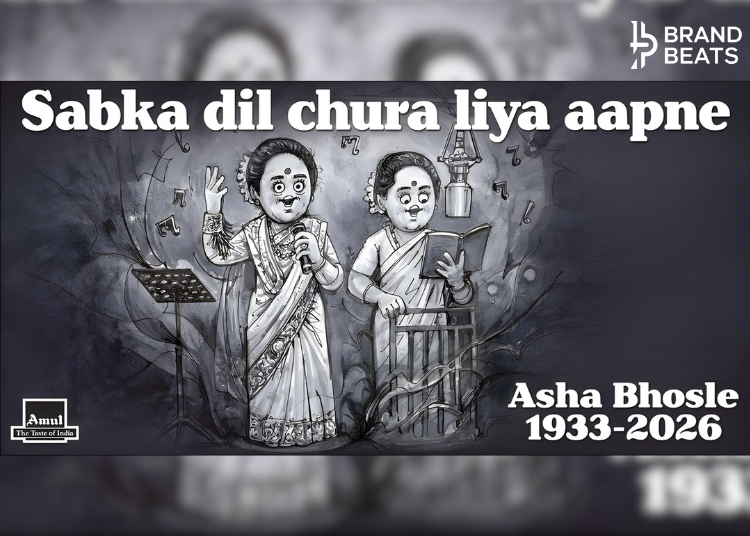
When a voice that has cradled a nation for 70 years finally falls silent, words often feel inadequate to measure the loss. The passing of Asha Bhosle at the age of 92 is not merely the end of a prolific career; it is the sunset of a rhythmic era that defined the heartbeat of Indian cinema. To honor this monumental transition, Amul released a poignant topical that leaned on the power of minimalist storytelling and deep-seated nostalgia.
The creative featured two contrasting illustrations of Bhosle, capturing her dual essence: the vibrant, magnetic charisma of a stage performer and the quiet, disciplined intensity of a master technician in the recording studio. This visual tribute served as a final standing ovation for an artist who didn’t just sing songs, but wove the very fabric of India’s musical identity.
Asha Bhosle was widely recognized as the ultimate sonic chameleon. Born in 1933 into the illustrious Mangeshkar family, she successfully carved a unique path by mastering genres that ranged from soulful ghazals and classical bhajans to high-energy pop and cabaret. Her career was defined by a fearless willingness to experiment, most notably in her legendary collaborations with composer R.D. Burman.
Together, they revolutionized the Indian soundscape by integrating jazz, disco, and rock elements into mainstream playback singing. While her accolades included the Dadasaheb Phalke Award and the Padma Vibhushan, her true impact lived in the way her voice transcended the barriers of age, geography, and language to become a permanent fixture in the daily lives of millions.
The emotional centerpiece of the Amul tribute was the evocative line, ‘Sabka dil chura liya aapne,’ a phrase that functions as both a playful nod to her past and a profound final eulogy. This line is a direct reference to the hit song ‘O Diwaano Dil Mera’ from the 1979 film The Great Gambler.
Composed by R.D. Burman with lyrics by Anand Bakshi, the song was originally set in a high-stakes casino sequence featuring Amitabh Bachchan and Zeenat Aman. The specific lyric ‘Sabka dil chura liya aapne, ye hunar kahan se sikha aapne?’
The popularity of this line ensured that the tribute felt deeply personal to every generation that grew up with her melodies as their constant companion. While the song originally celebrated a fictional ‘skill’ for stealing hearts within the glitz of a cinematic casino, Amul’s topical repurposed it to acknowledge Bhosle’s real-world mastery over the collective emotions of a nation. It serves as a respectful, final acknowledgment that while the singer has reached the end of her earthly journey, the millions of hearts she claimed through her seven-decade career remain irrevocably hers.
Link to the post:
View this post on Instagram