

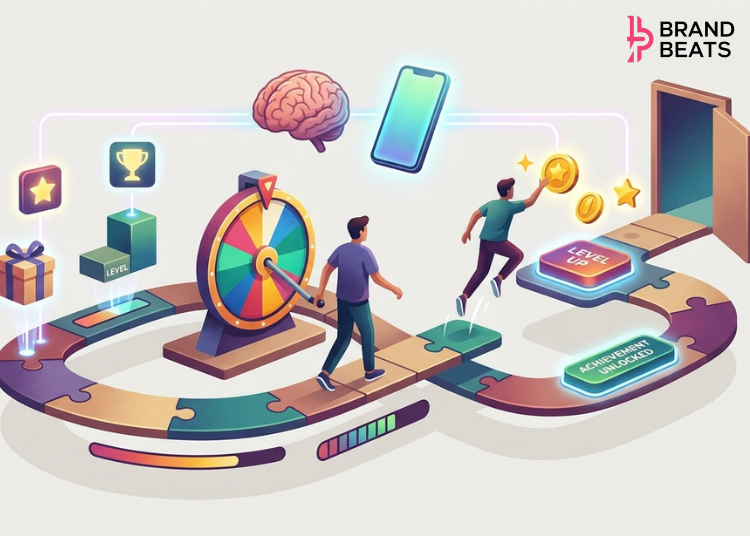
It all starts innocently.
A notification flashes on your screen: “Spin the wheel and win.”
You weren’t planning to shop. You weren’t even thinking about the brand. But you tap anyway.
The wheel spins. There’s a pause just long enough to build anticipation. You win 20% off.
Not a life-changing reward. Not even something you needed. But now, you’re curious. You start browsing. You add something to your cart. You leave. You come back.
Because now, it’s not just a transaction. It’s a loop you’ve entered.
Somewhere between that spin and that purchase, your behaviour shifted from passive observer to active participant. And that shift is not accidental, it is engineered.
Gamification, often misunderstood as a layer of “fun” added to marketing, is in reality a deeply psychological system. It doesn’t just capture attention, it shapes behaviour. And at a time when attention is fragmented and traditional advertising struggles to hold interest, gamification is emerging as one of the most effective ways to engage, retain, and convert users.
Built for the Brain: Why Play Comes Naturally
Gamification works because it aligns with how the human brain is wired. At a fundamental level, humans are drawn to play not just as entertainment, but as a mechanism for engagement and learning. When an activity offers a sense of challenge, reward, and progression, it activates neural pathways associated with motivation.
What makes this particularly effective is that the brain responds not only to rewards, but to the anticipation of rewards. The possibility of gaining something however small creates a sense of excitement that keeps users engaged. This is why even low-value incentives can drive high levels of interaction when presented within a gamified structure.
Brands like Duolingo have built entire ecosystems around this principle. The app transforms learning into a series of streaks, levels, and rewards, ensuring that users return not just to learn, but to maintain progress. The motivation is no longer purely functional; it becomes emotional and habitual.
The Power of ‘Almost’: Why Uncertainty Hooks You
If anticipation draws users in, uncertainty keeps them engaged.
Gamification thrives on variable outcomes situations where users do not know exactly what they will receive. This unpredictability creates a heightened level of engagement because the brain remains in a state of curiosity.
Consider how platforms like Amazon or Myntra use spin-the-wheel mechanics during sale periods. The rewards vary, and that variability is precisely what drives repeated interaction. Users return not just for the reward, but for the chance of a better one.
The psychology here is simple but powerful: certainty satisfies, but uncertainty excites. The feeling of being “close” to a better outcome of almost winning—can be more compelling than the reward itself. It keeps users engaged in a loop of anticipation and action.
Progress Is a Psychological Trap
Once a user starts engaging, the next challenge is retention. This is where progress becomes critical.
Gamified systems often introduce visible indicators of advancement progress bars, points, levels, streaks. These elements create a sense of movement, even when the actual outcome is still distant.
The reason this works lies in a behavioural bias: once people feel they have made progress, they are more likely to continue. Stopping midway feels like losing something already earned.
This is evident in platforms like Swiggy, where reward-based programs and milestone-driven offers encourage repeat usage. Users do not just place orders; they work towards unlocking benefits, creating a cycle of continued engagement. Progress, in this sense, is not just a feature. It is a commitment device.
Why Effort vs Reward Matters
However, engagement is fragile. Too little effort, and the experience feels trivial. Too much effort, and it becomes frustrating.
The effectiveness of gamification lies in maintaining a delicate balance between effort and reward. The task must feel achievable, but not effortless. The reward must feel meaningful, but not guaranteed.
Brands that succeed in gamification understand this balance. Nike, through its fitness ecosystem, creates challenges that are attainable yet motivating. Users are encouraged to push slightly beyond their comfort zone, with rewards that reinforce progress without feeling disproportionate.
This balance ensures that users remain engaged over time, rather than dropping off due to boredom or fatigue.
From Playing to Performing
Gamification becomes even more powerful when it introduces a social dimension.
Human behaviour is deeply influenced by comparison and recognition. When users can see how they perform relative to others, engagement takes on a new dimension. It is no longer just about participation; it becomes about performance.
Fitness platforms, gaming ecosystems, and even commerce-driven campaigns increasingly incorporate leaderboards and shareable achievements. Strava, for instance, turns individual activity into a social experience by allowing users to compare performance and share milestones.
This visibility transforms engagement into something more competitive and, in many cases, more persistent. Recognition becomes a reward in itself.
The Novelty Effect
Another reason gamification initially performs well is novelty. Interactive formats break the monotony of static content and offer users something different. This difference alone can drive high engagement in the short term.
However, novelty is inherently temporary. What feels new today becomes familiar tomorrow. A mechanic that once felt exciting can quickly lose its appeal if repeated without variation.
This is why brands must continuously evolve their gamified experiences. Platforms like Snapchat consistently introduce new interactive features to maintain user interest. Without this evolution, engagement plateaus.
Gamification, therefore, is not a one-time tactic. It requires ongoing innovation to remain effective.
Where It Gets Real
While gamification is often associated with engagement, its real impact is seen in conversion.
When users actively participate in an experience, they become more invested. This investment of time, attention, and effort reduces friction and increases the likelihood of action.
E-commerce platforms have been particularly effective in leveraging this. Limited-time games, reward-based interactions, and milestone-driven discounts create a sense of urgency and involvement that pushes users towards purchase decisions.
The shift from passive browsing to active participation changes the nature of the interaction. Users are no longer evaluating a product in isolation; they are completing a journey. And once that journey begins, the likelihood of conversion increases significantly.
Gamification succeeds because it aligns with human behaviour rather than trying to override it. It taps into our instinct to play, our attraction to uncertainty, our need for progress, and our desire for recognition. It transforms engagement from something passive into something participatory.
In a landscape where attention is fragmented and traditional formats are increasingly ignored, this shift is critical. Gamification does not demand attention; it earns it by making users part of the experience.
And once users start participating, they rarely stop halfway.
Because what feels like play on the surface is, in reality, a system designed to keep them engaged, invested, and returning.