

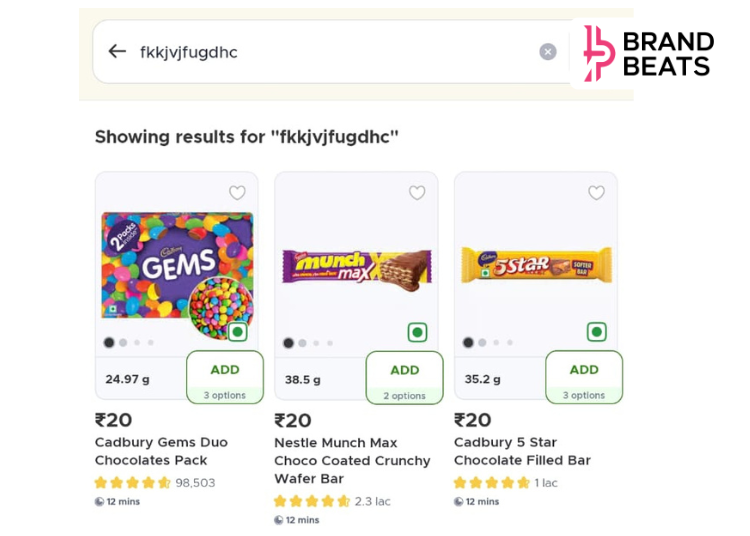
Blinkit is at the centre of a viral social media conversation after users discovered that its search function can identify products even when customers type complete gibberish.
The discussion began when a user on X (formerly Twitter) shared an unexpected experiment. While trying to convince their toddler that chocolates were unavailable, the parent typed random letters into Blinkit’s search bar, mimicking how a child might type on a keyboard. To their surprise, the app still returned chocolate-related results.
The post quickly gained traction online, with many users expressing amazement at how accurately the quick-commerce platform appeared to interpret seemingly meaningless inputs.
According to the viral post, Blinkit’s search engine was able to map nonsensical strings of characters to relevant product suggestions, leading users to speculate about the sophistication of the company’s search and recommendation systems.
What might seem like a quirky internet moment also highlights a growing focus among consumer-tech companies on predictive search experiences. Modern search systems increasingly rely on machine learning models that can identify patterns, correct spelling mistakes, interpret intent, and surface likely results even when user inputs are incomplete or inaccurate.
In Blinkit’s case, the viral example suggested the system may have been able to recognize behavioural patterns commonly associated with searches for chocolates or snacks, despite the absence of meaningful words.
As screenshots of the search results spread across social media, reactions ranged from admiration to concern.
While some users praised the feature as a sign of how advanced consumer technology has become, others jokingly described it as “terrifying,” questioning how well digital platforms understand user behaviour. The debate quickly evolved beyond chocolates and into broader conversations around AI-powered personalization and recommendation systems.
Blinkit knows when your toddler has your phone, and it’s lowkey terrifying.
I was trying to trick my toddler that chocolates were out of stock, so I typed gibberish (the way a toddler would) into the search.
Look at the exact products the app served up as a fallback. pic.twitter.com/MubKhaxkNm
— Prem Soni (@ValueWithPrem) June 10, 2026