


Bombay Shaving Company has found itself at the centre of a debate around brand communication after a Bengaluru-based entrepreneur publicly criticised the company for allegedly flooding his WhatsApp inbox with promotional messages.
The discussion began when Debajyoti Jena, founder of The StartUp Circle, shared a post on LinkedIn claiming he had been forced to block three official WhatsApp business accounts associated with Bombay Shaving Company due to the frequency of marketing messages he was receiving. According to Jena, the brand was sending messages multiple times a day across multiple accounts, resulting in as many as nine promotional communications daily.
In his post, Jena questioned whether the repeated outreach was an intentional customer acquisition strategy and tagged several members of the company’s leadership team. While acknowledging his admiration for the brand and its founder, he described the experience as intrusive and urged the company to reconsider its communication practices.
The post quickly gained traction online, prompting a public response from Shantanu Deshpande, Founder and CEO of Bombay Shaving Company.
Responding in the comments section, Deshpande acknowledged the issue and apologised for the experience. “Should not have happened honestly.. apologies for this.. we’re trying to balance meaningful outreach without annoying customers.. will do better so sorry for this experience.”
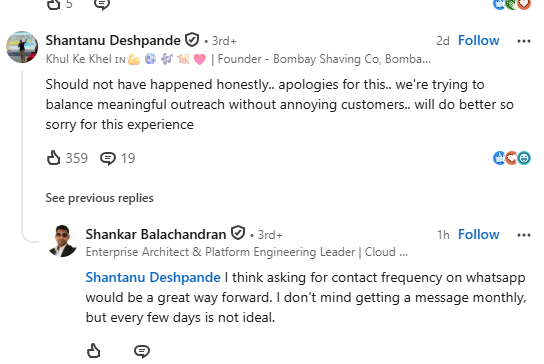
The incident has resonated with many social media users, several of whom shared similar experiences with promotional messages from brands across categories. The discussion has since expanded beyond Bombay Shaving Company, with users debating the fine line between personalised marketing and excessive communication.
As brands increasingly rely on WhatsApp, email, push notifications, and SMS to engage customers, the episode highlights a growing challenge for marketers: staying top of mind without becoming a source of frustration. While direct communication channels offer higher engagement rates than traditional advertising, consumers are also becoming more sensitive to message frequency and notification fatigue.
For Bombay Shaving Company, the issue appears to have been addressed swiftly through the CEO’s public response. But the conversation it sparked serves as a reminder that in an era of always-on marketing, relevance and restraint may be just as important as reach.