

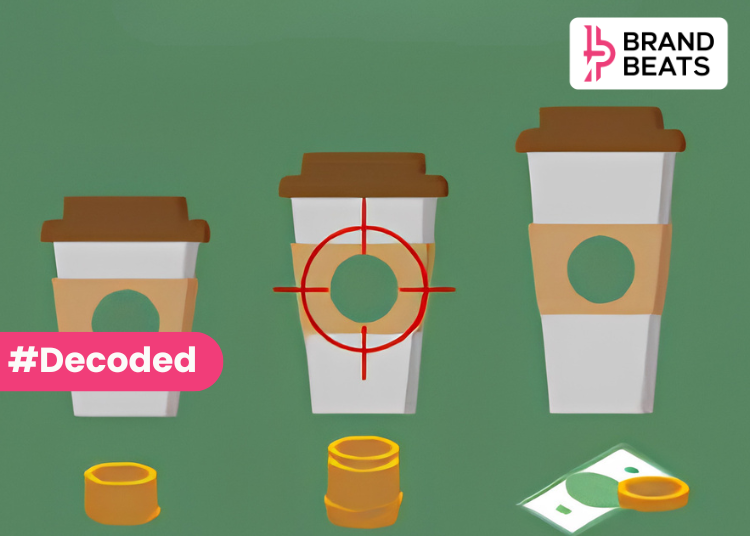
You open a food delivery app looking for a quick snack.
One combo costs ₹199.
Another costs ₹219.
And then there’s a third combo at ₹399.
Without thinking too much, you pick the ₹219 option.
“It seems like the best value,” you tell yourself but what if that ₹399 combo wasn’t designed to sell at all? What if its entire purpose was to make ₹219 feel like the obvious choice?
This is the Decoy Effect, one of the most fascinating principles in marketing psychology. Unlike discounts, offers, or flashy advertisements, the Decoy Effect doesn’t change the product. It changes the context in which you see it. And often, that’s enough to change your decision.
What Exactly Is the Decoy Effect?
The Decoy Effect occurs when a brand introduces a third option whose primary purpose isn’t to be chosen but to make another option appear more attractive.
Behavioral economists call it the Attraction Effect or Asymmetric Dominance Effect. The decoy is intentionally designed to be inferior to one option while remaining comparable to another. This makes the “target” option look like the smartest choice.
Imagine you’re offered:
| Plan | Price |
|---|---|
| Basic | ₹299 |
| Premium | ₹599 |
Many consumers would choose Basic.
Now add:
| Plan | Price |
| Basic | ₹299 |
| Standard | ₹549 |
| Premium | ₹599 |
Suddenly Premium doesn’t seem expensive anymore. For just ₹50 more, you’re getting significantly more value. Nothing changed about Premium, only the comparison changed.
And that’s the entire magic of the Decoy Effect.
Why Our Brains Fall For It Every Time
Humans don’t evaluate value in absolute terms; instead, we judge products by comparing them with the options around them. When deciding whether something is worth buying, our brains rarely ask, “Is this objectively worth ₹599?” Instead, we tend to think, “Is this a better deal than the other choices available?”
The Decoy Effect takes advantage of this natural mental shortcut. Rather than carefully calculating the true value of each option, consumers compare products side by side and are drawn toward the one that appears to offer the best value relative to the others.
Research in behavioral economics has shown that introducing a strategically inferior option can significantly influence consumer preferences, making one choice seem more attractive without changing the product itself. In other words, the decoy doesn’t alter the offering, it alters how we perceive it.
How Real Brands Use The Decoy Effect
The Decoy Effect isn’t limited to textbooks and psychology studies. It’s a pricing strategy used by some of the world’s biggest brands to influence how consumers perceive value and make purchasing decisions. While brands may not explicitly call it the Decoy Effect, the principle is visible across product lineups, subscription plans, food menus, and ecommerce bundles.
Apple:
Apple rarely launches a single version of a product. Instead, consumers are often presented with:
- iPhone 128GB
- iPhone 256GB
- iPhone 512GB
Or:
- MacBook Air
- MacBook Pro
- Higher-end MacBook Pro
The mid-tier option frequently acts as a reference point that makes upgrading feel rational.
A consumer who originally planned to spend less suddenly starts thinking: “For a little more, I get double the storage.”
The additional storage may not even be necessary, but the comparison makes it feel sensible. Apple’s product architecture has often been cited as a real-world application of decoy pricing and upselling psychology.
Starbucks:
Starbucks’ cup sizes are a textbook example.
Customers see:
- Tall
- Grande
- Venti
The middle option frequently functions as a comparison anchor. When the price gap between Grande and Venti feels relatively small, many customers justify upgrading. The goal isn’t necessarily to sell the largest drink. It’s to make the larger drink feel like the smartest value purchase.
Swiggy and Zomato Combos
Open almost any restaurant menu on Swiggy or Zomato and you’ll see:
- Single Burger: ₹149
- Burger + Fries: ₹199
- Burger + Fries + Drink: ₹219
The jump from ₹199 to ₹219 feels tiny compared to the added value.
As a result, consumers often spend more than originally intended. Users discussing menu pricing on Indian forums have repeatedly pointed out how combo structures often function as decoys to push higher-value orders.
D2C Brands and Bundle Packs
Many Indian D2C brands now structure offers like:
- Buy 1: ₹499
- Buy 2: ₹899
- Buy 3: ₹999
Suddenly buying three products feels more economical than buying two. Consumers end up increasing basket size because the third option makes the second one seem inefficient. Beauty, nutrition, grooming, and wellness brands increasingly rely on this tactic because it boosts average order value while still feeling consumer-friendly.
Why Marketers Love The Decoy Effect
The Decoy Effect remains one of marketers’ favourite pricing strategies because it helps solve a longstanding challenge: consumers naturally gravitate towards cheaper options, while brands often want to drive sales of higher-margin products.
By introducing a strategically placed decoy, brands can make a premium offering appear significantly better value without directly pushing customers towards it. The result is that consumers feel they are making the smarter choice on their own, rather than being persuaded by marketing.
Research has consistently shown that decoy pricing can influence purchasing decisions and shift consumer preference towards a target product. Even small improvements in conversion rates can translate into substantial revenue gains for large businesses, which is why the strategy is widely used across subscription plans, restaurant menus, smartphone line-ups, OTT platforms, and ecommerce bundles. More importantly, the Decoy Effect highlights a fundamental truth about consumer behaviour: people rarely evaluate products in isolation.
Instead, they judge value based on the alternatives presented alongside them. A product that appears expensive in one context can seem like a bargain in another. For marketers, the lesson is clear success isn’t always about changing the product itself, but about shaping the comparisons consumers use to evaluate it. In many cases, the product that wins isn’t necessarily the best option; it’s simply the one positioned next to the right decoy.