
Every e-commerce journey builds toward a single moment: checkout.
By the time a user reaches here, most of the hard work is done. Discovery, comparison, and validation are complete. The intent to purchase is already formed. And yet, this is also where a disproportionate number of users drop off.
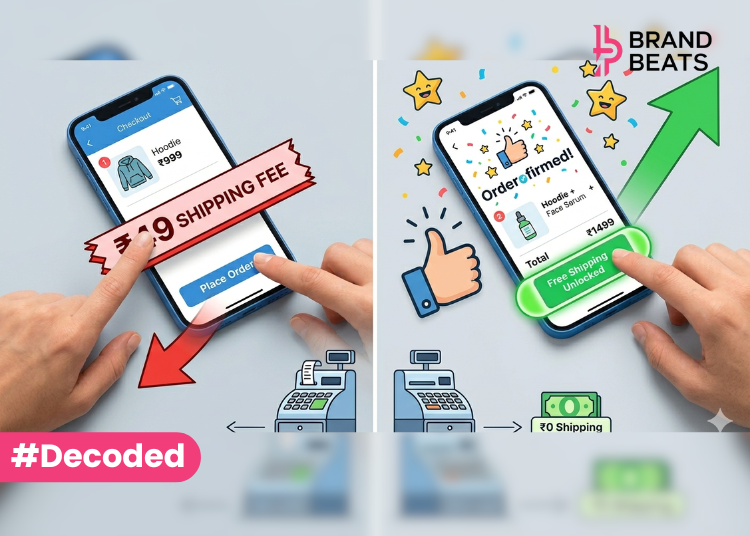
The reason is rarely the product. It’s the last-minute addition. A small shipping fee Rs 49, Rs 79, Rs 99 appears almost as an afterthought. But psychologically, it lands very differently. It interrupts momentum. It reframes the purchase. It makes the user pause.
Now replace that with a simple shift: ‘Free shipping unlocked.’
The hesitation disappears. The same user who was reconsidering is now completing the purchase often faster, and sometimes with a higher cart value than intended.
This is not a pricing strategy. It’s behavioral design.
Why Is Zero Not Just Another Number?
At the center of this behaviour is the Zero Price Effect, a well-established principle in behavioral economics. It explains why consumers place disproportionately high value on items or benefits that are free, even when the financial advantage is negligible or worse, nonexistent.
Research consistently shows that when the price of something drops to zero, demand spikes sharply. This isn’t linear. The jump from Rs 50 to Rs 0 is far more powerful than from Rs 100 to Rs 50, even though both represent the same difference.
Free doesn’t just mean cheaper. It signals no risk, no downside, no penalty. And that dramatically alters how decisions are made.
The Pain of Paying, Why Shipping Feels Like a Penalty?
One of the biggest reasons free shipping outperforms discounts is rooted in what behavioral scientists call the pain of paying. Every time a consumer sees a cost added at checkout, it creates a small psychological discomfort.
Shipping fees amplify this effect because they feel detached from value.
The product is tangible. It can be used, worn, consumed. Shipping, on the other hand, feels like a necessary inconvenience, an extra charge that doesn’t translate into ownership or experience.
So when a user sees a Rs 50 discount, it registers as a benefit. But when they see a Rs 50 shipping fee, it registers as a loss. And removing that loss creates a stronger emotional response than adding an equivalent gain.
The Illusion of Fairness
This behavior is closely tied to loss aversion, the tendency for people to feel losses more intensely than gains of the same size. A shipping fee feels like something being taken away. A discount feels like something being given. Even if the final price is identical, the emotional journey is not.
There’s also an underlying perception of fairness at play. Consumers expect to pay for products. They don’t always expect to pay for delivery, especially in a digital-first commerce environment where instant gratification has been normalized. So when shipping is free, the transaction feels cleaner, fairer, and more aligned with expectations. When it isn’t, it introduces a subtle friction that can derail the decision.
Consumers don’t treat all money equally. They assign it to mental categories. Product cost belongs to the ‘value’ bucket. Shipping cost falls into the “overhead” bucket, it feels unnecessary and avoidable.
Free shipping works because it removes a cost category that consumers are already biased against.
When Spending More Feels Like Winning
One of the most effective applications of free shipping is not offering it outright, but attaching it to a condition. “Add Rs 200 more to unlock free delivery.” This taps into what psychologists call the goal gradient effect, the tendency for people to increase effort as they get closer to a reward. Instead of viewing the additional spend as a cost, users start viewing it as progress. The purchase becomes a task to complete rather than a decision to evaluate.
This is why consumers often end up spending Rs 100–Rs 300 more than intended just to avoid a Rs 50 fee. The perceived reward outweighs the actual math.
How Brands Turn This Into a Growth Lever
What makes this phenomenon powerful is how consistently it translates into business outcomes across categories.
- Amazon has arguably built one of the most successful behavioral loops around free shipping. By embedding it into Prime, the company removes shipping from the decision-making process entirely. Over time, this has trained users to expect frictionless delivery, reducing sensitivity to product pricing while increasing purchase frequency.
- Beauty and lifestyle platforms like Nykaa go a step further by designing their product mix around this behavior. Low-ticket add-ons are strategically positioned to help users cross free shipping limits, effectively turning small, impulse purchases into a scalable revenue lever.
- Zomato integrates free delivery into subscription models, transforming it from a one-time incentive into a long-term retention strategy. Once users internalize that delivery is “free,” their ordering frequency increases, not because each order is cheaper, but because the friction associated with ordering has been removed.
Across multiple studies and industry analyses, a consistent pattern emerges. Free shipping tends to outperform equivalent discounts in driving conversions. It reduces cart abandonment, increases average order value when tied to thresholds, and accelerates decision-making at checkout.
More importantly, it simplifies pricing perception. A clean, all-inclusive price feels easier to process than a fragmented one with additional charges layered at the end. This clarity alone can significantly improve purchase completion rates.
Because at the point of purchase, even a small cognitive hurdle can feel like too much effort. And the brand that removes that hurdle, not the one that offers the biggest discount is often the one that wins.