

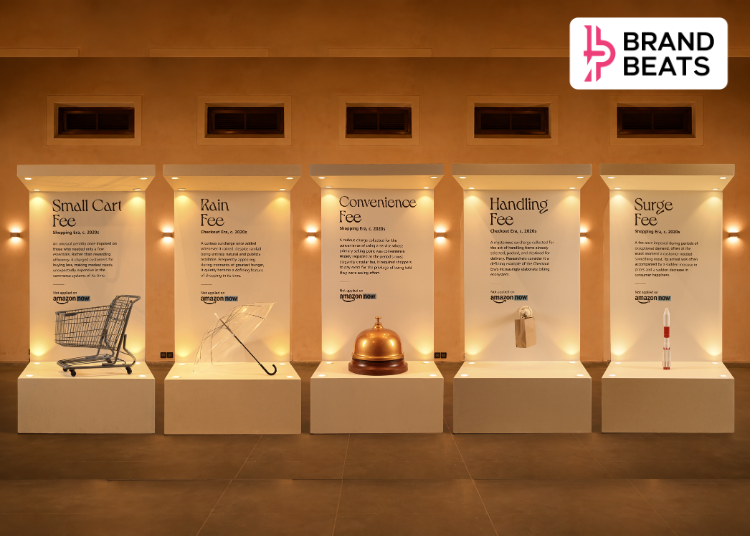
Somewhere along the way, paying extra at checkout became normal. Handling charges, rain fees, convenience fees, surge pricing and small cart fees quietly became part of online shopping. Amazon Now‘s latest campaign flips that reality on its head by asking: What if all those charges belonged in a museum instead?
Created by independent creative agency Social Panga, ‘The Museum of Unnecessary Charges’ is a two-day public installation that transforms familiar checkout fees into oversized museum exhibits. Instead of art, visitors encounter handling charges, rain fees, convenience fees and surge pricing displayed as relics from an era shoppers would rather leave behind.
A giant hand clutching a shopping bag takes aim at handling charges, while a transparent umbrella pokes fun at rain fees. The exhibits use humour and exaggeration to spotlight fees consumers have quietly accepted over the years.
Satire Meets Experiential Marketing
The campaign also includes a digital film featuring comedian Biswa Kalyan Rath, who wanders through the museum offering dry, understated observations on the logic behind these charges. Rather than relying on product claims, the film lets satire carry the message.
Instead of another price-led campaign, Amazon Now turns a familiar checkout frustration into an interactive experience. The result is a campaign that swaps feature-heavy advertising for storytelling, encouraging shoppers to question whether some charges deserve a place in history rather than on their bills.
Watch the campaign
Gaurav Arora, Co-Founder, Social Panga, said, “The strongest ideas begin with a human truth but flourish because of execution. Functional propositions are often the hardest to make memorable, so our approach is to find a cultural expression of the truth we’re trying to tell.”
He further added, “’The Museum of Unnecessary Charges’ came from asking a simple question: if these charges were becoming a thing of the past, where would they then actually belong? The answer gave us a platform that could live as an experience, a film and a social conversation, while staying rooted in the brand’s core proposition.”
Soumabha Nandi, Executive Vice President, Creative and Strategy, Social Panga, reflected on why satire felt like the right language for the idea. “It’s been a while since advertising embraced satire. Somewhere along the way, we became more interested in making claims than making people pause. Satire works because it doesn’t point fingers; it simply holds up a mirror.”
He further added, “You laugh because it’s familiar, and only a moment later realise the joke is on all of us. That felt like the right way to tell a consumer truth people had quietly normalised over the years. Once that insight was clear, the museum became inevitable. It couldn’t exist as a visual metaphor; it had to be a real place that people could walk into, experience and question for themselves. Sometimes, the most honest expression of an idea is simply to build it for real.”