

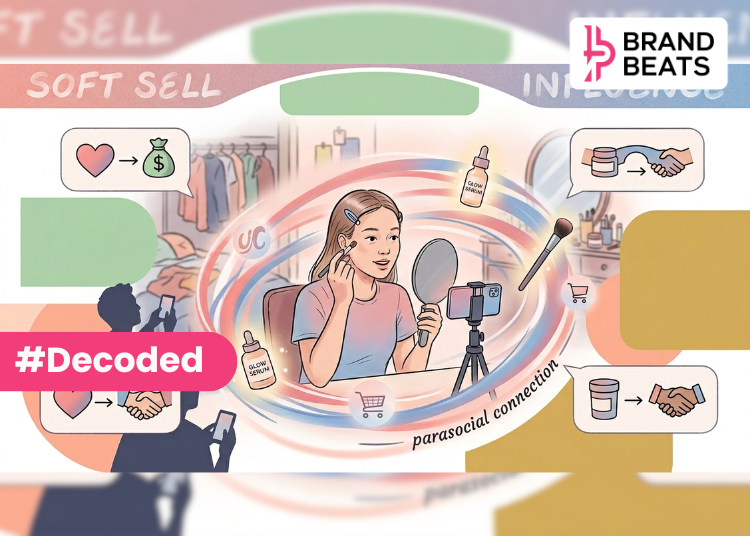
It always begins the same way: quiet, unfiltered, almost accidental. A creator sits in front of a mirror, hair clipped back, face bare, speaking as though the camera isn’t there. “Get ready with me,” she says, and suddenly, the viewer is no longer just scrolling, they are present. What follows is not a performance in the traditional sense. She talks about her day, her anxieties, a fleeting thought that crossed her mind that morning. There is no script, no overt hook, no urgency to sell. And yet, by the end of those few minutes, the viewer has absorbed far more than just a routine. They’ve internalised preferences, product choices, and aesthetics without ever being asked to.
This is the defining power of the GRWM format. It earns intimacy. And in today’s attention economy, intimacy is far more valuable than visibility. The content doesn’t feel like it is addressing a mass audience, it feels like it is meant for you. That illusion, carefully constructed yet effortlessly delivered, is what makes GRWM one of the most potent forms of modern marketing.
How GRWM Rewires Consumption
At its core, GRWM is deceptively simple, creators film themselves getting ready while talking to their audience. But what appears to be a mundane routine is, in reality, a carefully structured narrative. Each step skincare, makeup, styling unfolds in sequence, drawing the viewer deeper into the process. The products are not introduced as objects to be evaluated; they are presented as natural extensions of the creator’s life.
This shift is crucial. Traditional advertising asks consumers to consider a product. GRWM allows them to experience it vicariously. As viewers watch a foundation being blended or an outfit coming together, they begin to imagine themselves in the same scenario. The act of consumption is no longer hypothetical; it feels lived. This creates a subtle but powerful psychological effect: the viewer doesn’t just want the product; they feel as though they already understand it, even own a part of it.
The Illusion of Friendship and the Currency of Trust
What truly elevates GRWM from content to conversion is its ability to mimic friendship. The creator speaks casually, often digressing into personal stories that have little to do with the routine itself. These messy, unstructured, and deeply human moments are what anchor the viewer emotionally. Over time, repeated exposure builds familiarity, and familiarity breeds trust.
This is where the concept of parasocial relationships becomes central. The viewer begins to feel connected to the creator, not as a distant influencer but as someone within their emotional orbit. Recommendations delivered within this context carry a different weight.
Take Rida Tharana, for instance. Her GRWM-style videos rarely feel like structured routines. Instead, they unfold like candid conversations often layered with personal anecdotes, opinions, or social observations. The products exist, but they are secondary. What audiences return for is her voice, her perspective, her energy. And that is precisely why the influence works. By the time a product appears, the viewer is already engaged not with the item, but with her.
A similar shift can be seen with Ankush Bahuguna, who has redefined GRWM by blending humour, vulnerability, and gender-fluid beauty content. His “wing it with Ankush” style videos feel less like tutorials and more like self-expression in motion. When he uses a product, it doesn’t come across as an endorsement; it feels like experimentation. This reduces the pressure to “buy” and instead invites the audience to explore, making the eventual influence far more organic.
Meanwhile, fashion-focused creators like Komal Pandey elevate GRWM into a form of visual storytelling. Her videos often transform the simple act of getting ready into a narrative arc, complete with mood, theme, and identity play. In this context, products are not just functional; they become part of a larger aesthetic aspiration.
What ties all these creators together is not the format itself, but how they personalise it. GRWM, in the Indian context, has become a framework rather than a formula flexible enough to accommodate humour, storytelling, chaos, or calm. And within that flexibility lies its marketing power. Because when content feels personal, influence feels earned.
The New Aesthetic of Influence
Unlike the hyper-polished advertisements of the past, GRWM thrives on imperfection. The lighting isn’t always perfect, the room isn’t always tidy, and the creator isn’t always composed. This rawness is not a flaw; it is the format’s greatest strength. It signals authenticity in a way that traditional marketing cannot replicate.
Perhaps the most defining feature of GRWM is how seamlessly it integrates products into its narrative. There are no hard sells, no explicit calls to action. Instead, products appear organically picked up, used, and sometimes casually mentioned. “I’ve been loving this lately,” a creator might say, almost as an aside. But that aside is doing significant work.
By embedding products within a larger story, GRWM removes the friction typically associated with advertising. The viewer is not evaluating a product in isolation; they are seeing it in context, how it fits into a routine, how it complements a look, how it contributes to a mood. This contextualisation reduces resistance and increases acceptance. The product doesn’t feel like an external recommendation; it feels like an internal choice waiting to be made.
Why Brands Are Betting Big on GRWM
For brands, GRWM represents a solution to one of the most pressing challenges in modern marketing: declining trust. Consumers today are increasingly skeptical of overt advertising, often skipping, blocking, or ignoring it altogether. GRWM bypasses this resistance entirely by never presenting itself as advertising in the first place.
Instead, it operates within the ecosystem of content blending entertainment, relatability, and utility into a single format. This makes it particularly effective among younger audiences, who value authenticity and peer recommendations over brand messaging. The result is a form of marketing that feels less like persuasion and more like participation.
Yet, this very subtlety raises important questions. As GRWM continues to blur the boundaries between personal expression and commercial intent, the issue of transparency becomes increasingly complex. When does a genuine recommendation become a paid promotion? And does the audience always know the difference?
The lack of clear disclosure in many GRWM videos has sparked growing debate, particularly as viewers become more aware of influencer marketing tactics. At the same time, the rise of “de-influencing” trends suggests a shift in audience behaviour, one that is more critical, more questioning, and less willing to accept content at face value.
GRWM works because it taps into something fundamentally human: the desire for connection, guidance, and shared experience. It doesn’t push products onto the viewer; it invites them into a world where those products already belong. And in doing so, it achieves what traditional advertising often cannot, it makes consumption feel natural.
By the time the video ends, the viewer may not remember every detail of the conversation. But they will remember the routine. The products. The feeling.
And more often than not, that is enough.