

Remember when ‘That Boho Girl’ made us want to raid Sarojini Nagar and Janpath for the coolest accessories without burning a hole in our pockets?
But what happens when that same girl launches her own jewellery brand? You’re thrilled, you’re excited, you’re ready to shop! Well, at least that’s how it was supposed to go. Sadly, influencer Kritika Khurana’s latest launch has left some of her followers feeling everything but excitement.
For years, Kritika, better known as ‘That Boho Girl,’ built her identity (and content) around bohemian fashion, statement accessories and outfits. For many young followers, she was the influencer who made experimenting with fashion look fun, personal and accessible.
But with her latest entrepreneurial venture, Kritika Khurana Jewels, the conversation has taken a different turn. And this time, it is not about an outfit she styled or a look she served. It is about the price tag.
The Price Tag, The Product & The Problem
Kritika’s new jewellery label features bold, statement-making pieces designed to be layered, mixed and worn in different ways.
In the founder’s note on the brand’s website, she explains that her love for jewellery comes from collecting pieces from markets, travels and vintage finds. The idea, she says, was to create jewellery that feels collected rather than simply bought.
However, the pricing has become a talking point in her own comment section, where users have questioned whether the products justify their cost.

A look at the brand’s website shows pieces priced at Rs. 950 at the lower end, while designs such as Eris are listed at Rs. 8,450 and Theia at Rs. 11,450. Several other pieces fall in the Rs. 3,000–Rs. 6,000 range.
For followers who remember Kritika’s market-inspired fashion days, these prices have prompted a familiar question: if similar-looking jewellery can be found in local markets, what makes these pieces worth the premium?
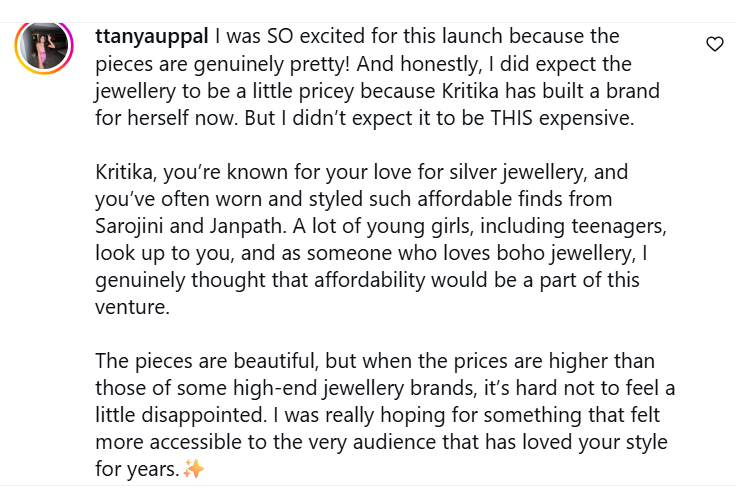
More than the prices themselves, the conversation has also turned to the audience Kritika has built over the years.
A large part of the conversation is not necessarily anger, but criticism and feedback from an audience that has followed Kritika for years and feels connected enough to be candid with her. A quick scroll through her comment section often reveals younger followers addressing her as ‘di’ (big sister), reflecting the familiarity they feel with the influencer they have grown up watching.
Many of them are teenagers or college-goers who look to her for fashion inspiration, often with affordability in mind. So, if a large part of your audience is still in college, juggling pocket money and limited budgets, how do you convince them to spend thousands on jewellery?
This is perhaps what some of her admirers want to ask, even as they continue to wish her nothing but the best for her new venture.


The discussion has also moved beyond the price tag.
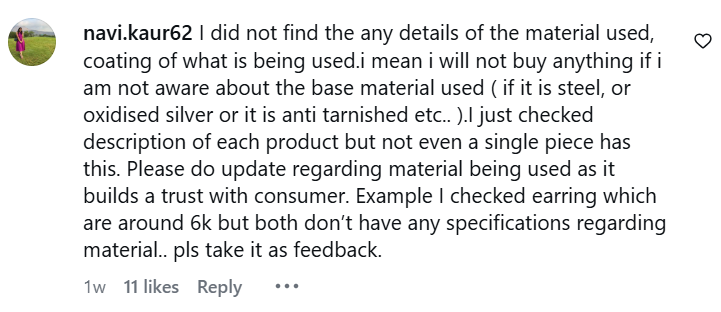
Some users have questioned the designs and finish, arguing that the pieces do not always look sufficiently distinctive for their listed prices. Others have raised concerns about material transparency and whether the jewellery’s anti-tarnish claims justify the premium.
Plus, users highlighted the lack of clear material information on the product listings.
Then there is also the comparison with brands such as Palmonas, co-founded by actor Shraddha Kapoor, which positions itself around affordable luxury and offers jewellery at a range of price points. Its website lists several pieces at discounted prices below Rs 1,500, while its collections also include 925 sterling silver jewellery starting at Rs 1,700.

The return policy has become another sticking point. According to the label’s official website, it follows a strict no-return and no-refund policy once an order has been successfully placed and delivered. Exchanges are permitted only for items that arrive damaged or broken, with customers required to report the issue within 24–48 hours and provide an unboxing video.
For shoppers spending several thousand rupees on fashion accessories, that restriction has added to the hesitation.
All in all, for Kritika, the challenge may be bigger than selling statement jewellery. It is about bridging the gap between the creator her audience grew up watching and the founder asking them to spend on a premium label.
Now, there is nothing wrong with an influencer building a brand at a higher price point, but when your appeal was once rooted in finding fashionable pieces without spending a fortune, the shift is bound to invite questions.