

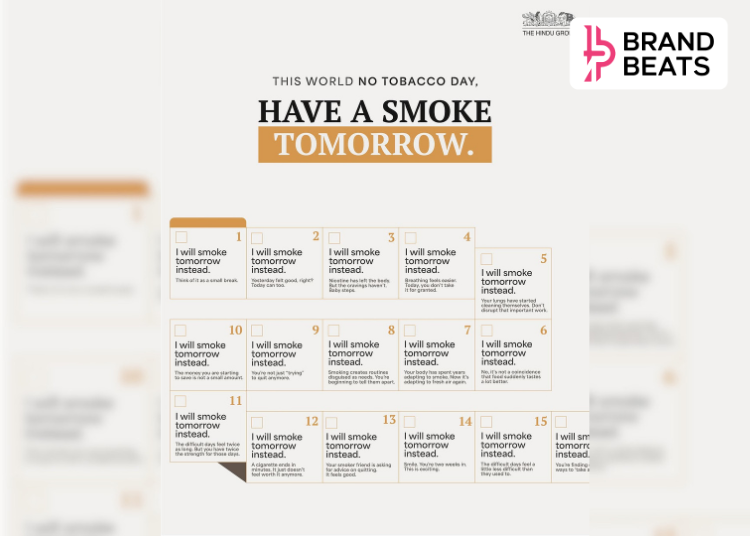
On World No Tobacco Day, Indian newspaper The Hindu, in partnership with ad agency Talented, released an anti-smoking public service advertisement. The campaign’s central idea is built on a behavioural pattern common among smokers: repeatedly postponing the decision to quit. Instead of fighting that tendency, the ad uses it as the quitting mechanism itself.
The campaign takes the form of a monthly calendar, with each date carrying the message, ‘I will smoke tomorrow instead.’ Built around the idea of postponing rather than abruptly quitting, the initiative is anchored by the ‘This World No Tobacco Day, have a smoke tomorrow.’ The message is further extended through social media, where users are encouraged to delay smoking with the line, ‘Today is a great day to smoke a cigarette tomorrow instead.’
View this post on Instagram
Each date on the calendar also includes a short note on what happens in the body during smoking abstinence. Within 20 minutes of the last cigarette, the body begins to recover as blood pressure starts returning toward normal levels. After 8 hours, carbon monoxide in the blood drops. By 48 hours, nicotine is fully cleared from the body. Within weeks, lung function improves, and breathing becomes easier. These milestones are placed beside each day’s checkbox so the smoker can track physical recovery while continuing to delay the next cigarette.
The strategy works by replacing one large, open-ended commitment, ‘I will never smoke again,’ with a series of small, single-day decisions. Each day, the smoker only commits to not smoking today. The option to smoke tomorrow is never taken away. This lowers the psychological cost of each decision and makes follow-through more manageable.
Whether it drives measurable quit rates remains to be seen. But the campaign takes a different approach from many anti-smoking initiatives. Rather than relying on fear, guilt, or moral appeals, it works with an existing behavioural pattern and encourages smokers to postpone the next cigarette, one day at a time.