

If you grew up in India, one phrase reverberates louder than most snack memories: “Bas do minute.” It is not just a cooking promise, it is an emotional cue. In India, noodles eventually came to mean Maggi, not just as a product, but as a cultural shorthand for quick comfort.
Long before food delivery apps promised convenience at the tap of a screen, Indian kitchens relied on something simpler, a yellow packet that offered certainty. Two minutes. No planning. No negotiation with hunger.
Maggi grew up quietly alongside a changing India. It fed children waiting for their school bags to be unpacked, students surviving on hostel stoves, and families navigating days when time ran out before energy did. Somewhere along the way, noodles stopped being a category and started becoming a name.
The yellow packet, its familiar aroma, and its predictable comfort slipped into everyday life — as routine as evening chai, as dependable as a late-night snack.

Fitting Into a Changing India
When Nestlé introduced Maggi instant noodles to India in 1983, the odds were uneven. Indian kitchens were anchored in freshly cooked meals, and packaged food carried skepticism. Noodles felt foreign, convenience felt suspicious.
Maggi didn’t fight that instinct. It worked around it.
Rather than positioning itself as food that replaced tradition, Maggi presented itself as food that filled gaps, moments when cooking felt like effort and time felt scarce. And India, quietly, was changing. Urbanisation was accelerating. Nuclear families were growing. More women were entering the workforce. The constraint wasn’t appetite, it was time.
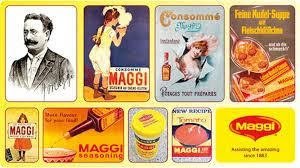
Everything about the brand reinforced memorability without demanding attention. The yellow pack stood out without explanation. The masala flavour felt instantly familiar. The name was short, easy to say, easy to repeat. Maggi didn’t rush acceptance. It allowed familiarity to do the work.
“Bas Do Minute”: Turning Speed Into Meaning
Maggi’s most important move was also its simplest. It promised speed and never complicated it.
“2-Minute Noodles” was not just a functional claim. It was an invitation. It slipped neatly into existing routines instead of asking consumers to build new ones. Working mothers didn’t have to rethink dinner. Students didn’t have to learn to cook. Households didn’t have to change habits. Maggi simply appeared when time disappeared.
Availability did the rest. Priced within reach, distributed aggressively, present everywhere from metros to small towns, from supermarkets to kirana stores. Live demonstrations and sampling reduced hesitation. The product wasn’t just seen, it was tried.
When a Product Became a Presence in Indian Homes
As Maggi grew older, its advertising grew quieter. The brand no longer needed to explain what it was or how it worked.
Campaigns like “Rishte Maange Bas Do Minute” marked that shift. The storytelling moved away from preparation and toward presence. The insight was subtle but precise: as lives became faster, shared moments became rarer.
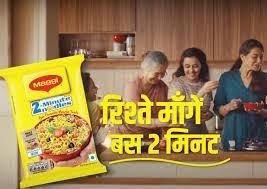
Maggi positioned itself not as the centre of the moment, but as the reason the moment could happen at all. Two minutes was no longer about speed it was about pause. Conversations after school. Quiet kitchen exchanges. Late-night work breaks.
Over time, Maggi stopped being something people chose. It became something people relied on. Which is why what happened next felt so abrupt.
2015: When Trust Collapsed Overnight
In March 2015, reports emerged from Barabanki, Uttar Pradesh, alleging that Maggi samples contained lead levels far above permissible limits and mislabelled MSG content. What began as a regulatory issue escalated rapidly.
Television debates replaced advertising slots. Social media amplified fear and disbelief. #MaggiBan spread faster than any campaign the brand had ever run.
On 5 June 2015, the Food Safety and Standards Authority of India ordered a nationwide recall. Maggi vanished from shelves almost overnight. Production stopped. Over 30,000 tonnes of product were destroyed. Sales collapsed by nearly 90 percent. Nestlé India reported its first quarterly loss in over fifteen years.
But the damage went beyond numbers.
For consumers, this wasn’t just about safety. It felt personal. A brand that had positioned itself as dependable almost familial was suddenly being questioned. Years of emotional reassurance collapsed within a news cycle.
How Listening Became Maggi’s Strongest Response
Nestlé’s first response was technical and controlled. The company maintained that it did not add MSG to Maggi noodles and questioned the accreditation of certain testing laboratories. At the same time, it complied fully halting production, recalling stock, cooperating with authorities.
The legal battle ran parallel. Nestlé challenged the ban, called for testing in NABL-accredited labs, and was eventually cleared of excess lead. But legal permission to return did not guarantee acceptance.
Because this crisis was no longer about compliance.
It was about belief and belief could not be argued back.
Maggi Reconnected by Feeling Before Fixing
The shift came when Nestlé stopped speaking and started listening.
Maggi’s first reconnection didn’t announce a comeback. It acknowledged absence. #WeMissYouToo surfaced moments that had gone quiet in hostel kitchens, late-night cravings, everyday routines interrupted. The brand didn’t position itself as returning. It positioned itself as missed.

#NothingLikeMaggi followed, reinforcing what consumers already felt – that Maggi wasn’t interchangeable. It invited people to share memories, not opinions. The communication avoided superiority. It leaned into irreplaceability.

Even the packaging changed. The “No Added MSG” claim was removed not as an admission, but as clarity. Messaging shifted to safety, quality, and transparency. Families replaced corporate voices. Familiar faces replaced assertions.
In 2018, “Kuch Achha Pak Raha Hai” widened the narrative further. Manufacturing processes were shown. Quality checks were highlighted. At the same time, the campaign reflected evolving Indian households – shared responsibility, changing roles, openness.

These weren’t loud corrections. They were quiet recalibrations.
Finding Its Way Back to Indian Kitchens
Maggi returned to shelves in November 2015, timed around Dhanteras — a period associated with renewal and trust. There were no aggressive claims. No dramatic relaunches. Distribution resumed carefully. Advertising leaned on familiarity.
Consumers returned gradually. Then decisively.
Years of shared moments did what explanations could not. Maggi regained market share and re-established itself as category leader — not because it convinced consumers, but because it reminded them.
What the Story of Maggi Reveals
Maggi survived its darkest chapter not because it defended itself better, but because it understood what it had built before the crisis ever arrived. A place in everyday life. A role in routine. A quiet dependence.
And relationships built patiently, over time, are far harder to erase.
Today, Maggi sits in a position few Indian FMCG brands ever reach category leader by default, not debate. It continues to dominate the instant noodles segment, while steadily expanding its role in the modern Indian kitchen through variants, formats, and adjacencies that respond to changing consumption patterns.

Four decades after its arrival, Maggi is no longer just India’s instant noodle leader. It is a benchmark for how mass brands can grow, falter, and still endure by staying close to the lives they serve.