

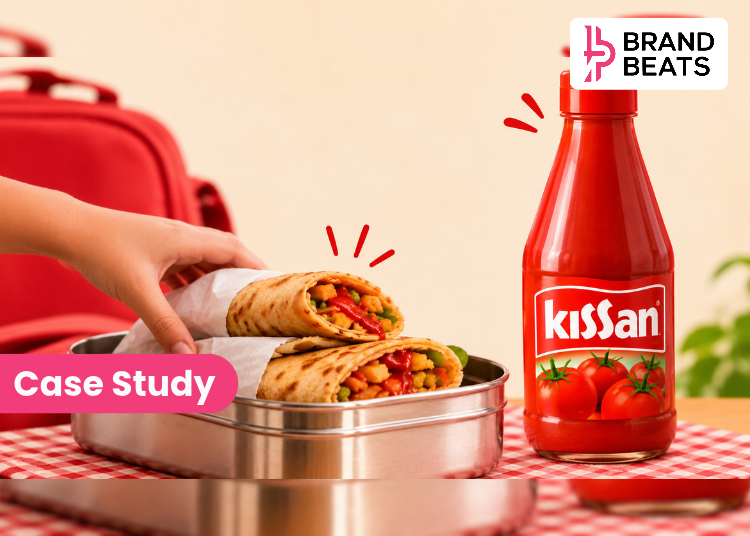
There is a particular kind of negotiation that happens in Indian households every morning. A mother packs a lunchbox, a child looks at the food, makes a face and announces that they do not want to eat it. The parathas are too boring, the sabzi is not interesting enough, and yesterday’s favourite meal has somehow become today’s least favourite.
For most food brands, this might seem like an ordinary household problem. For Kissan, it became a marketing opportunity.
Instead of asking families to buy more ketchup or simply reminding them that it tasted good, the brand found a way to give the product a new job. A little ketchup, some leftover sabzi and a paratha could become a roll that a child would actually look forward to eating.
That simple idea became the foundation of one of Kissan’s most recognisable marketing platforms: Kissan Rolls.
The interesting part of the strategy was not just the recipe. It was the consumer insight behind it. Kissan understood that its product was often treated as an accompaniment, brought out when samosas, sandwiches or snacks were served. The challenge was to make ketchup relevant to more meals and more occasions.
Its marketing has not relied on making ketchup look extraordinary. Instead, it has worked towards making ordinary meals feel more exciting with ketchup.
And that is where the Kissan story becomes an interesting marketing case study.

From A Condiment On The Table To An Ingredient In The Meal
To understand the thinking behind Kissan Rolls, it is important to look at the category challenge the brand was trying to address.
Ketchup is a relatively low-involvement product. Consumers do not necessarily plan an entire meal around it. It is usually picked up when someone wants an additional flavour with their food. This also means that the occasions on which a household consumes ketchup can remain limited.
For Kissan, the opportunity was to increase those occasions.
The brand had to move beyond the conventional association of ketchup with snacks and position it as something that could be used while preparing everyday food.
Its Kissan Rolls campaign, which became prominent around 2012–13, was built around a familiar situation in Indian homes. Mothers wanted their children to eat the food packed in their tiffins, while children were often reluctant to eat the same vegetables and parathas repeatedly.
Kissan’s solution was straightforward: add ketchup to the sabzi, wrap it in a paratha and turn it into a roll.
The campaign gave this combination a name and an identity of its own. Instead of presenting ketchup as an extra dip, it made the product an ingredient in the preparation itself.
This was an important shift in how the brand communicated its use. It was no longer simply saying that ketchup made food taste better. It was demonstrating how ketchup could change the way a familiar meal was prepared and presented.
The idea also allowed Kissan to address two consumers at once. Mothers were given an easy way to make everyday meals more appealing, while children were shown a fun, more interesting version of food they already knew.
The brand was not asking families to change their eating habits or purchase an entirely new product. It was offering a small change to something they were already doing.
That is what made the campaign relatable. It connected a product benefit with an existing household behaviour instead of creating an artificial consumption occasion.
While many food advertisements concentrate on the taste of a product, Kissan has often built its stories around the person preparing the food and the person eating it.
An earlier example of this approach was the brand’s breakfast advertising featuring Mandira Bedi. In the campaign, she played a mother who had to chase her son around the house to get him to eat breakfast. Kissan’s intervention reversed the situation, making breakfast more enjoyable and changing the familiar morning struggle.
The idea came from consumer research into the everyday challenges mothers faced while getting their children ready for school. The research highlighted how feeding children was part of a larger morning routine involving uniforms, socks, breakfast and packing lunchboxes.
Kissan turned that insight into a product-led story.
Another memorable example was the Rahul Dravid-led Jam Jam Jammy campaign. Rather than relying only on product demonstrations, the advertising used a recognisable face and a playful approach to build familiarity with the brand’s jam range.
These campaigns helped establish an emotional association between Kissan and childhood food routines. The brand was not trying to own one particular meal. It was finding different ways to become part of the everyday relationship between parents, children and food.
The distinction matters because emotional storytelling works best when it is connected to a product’s actual role in people’s lives. Kissan’s advertising repeatedly returned to situations its consumers could recognise from their own homes.
Kissanpur: When A Ketchup Brand Got Children To Become Tomato Farmers
If Kissan Rolls demonstrated how a brand could create a new consumption occasion, Kissanpur showed how it could make consumers experience its product promise.
The campaign addressed another challenge for ketchup brands: consumer perceptions around the ingredients used in packaged ketchup.
Kissan wanted to reinforce its claim of being made from 100% real tomatoes. But instead of relying entirely on television advertisements to communicate this, it decided to let consumers experience the idea themselves.
The result was Kissanpur, an initiative that invited children and their families to grow their own tomatoes.
The campaign was built around a simple thought: Grow what you eat. Eat what you grow.
Kissan distributed tomato seeds through newspapers and created opportunities for children to plant and nurture tomato saplings at home. A particularly interesting part of the initiative was the tomato-shaped bottle cap, which was designed to carry seeds and could also be used as a small pot for growing a plant.
The brand also introduced a competitive element. Children were encouraged to grow tomatoes, with the best growers getting an opportunity to have their faces featured on personalised Kissan ketchup bottles.
The campaign extended beyond individual households. Kissan created a shared learning environment across 55 schools, involving more than 25,000 children in tomato-growing activities and visits to tomato farms.
This was not a one-day activation. Growing a tomato plant takes time, and Kissan used that period to maintain consumer engagement through print advertorials, radio, digital platforms, social media and public relations.
According to WARC’s campaign case study, 2.5 million households received tomato seeds. The campaign was associated with a 31% increase in brand value and a 23% increase in volume.
It also received industry recognition, including a Grand Prix at Spikes Asia, as highlighted in Hindustan Unilever’s annual report.
What made Kissanpur particularly interesting was how it connected a product claim with an actual consumer experience. Rather than simply telling people that the ketchup was made from real tomatoes, Kissan encouraged them to understand where tomatoes came from and what went into growing them.
It also brought together three different elements of the brand’s identity: food, family participation and farming.
For children, it was an opportunity to grow something themselves. For parents, it became an activity they could participate in with their children. For Kissan, it was a way to make its ingredient promise more tangible.
The Tiffin Timetable, Making Lunchbox Duty Fun!
Kissan’s focus on school tiffins did not end with Kissan Rolls. The brand revisited the same consumer insight through another campaign: Kissan Tiffin Timetables.
By this point, the challenge was not simply to make ketchup more appealing to children. It was also to give mothers more reasons to use Kissan products while preparing everyday meals.
The brand recognised that mothers often needed fresh ideas for school lunchboxes. Preparing a different, enjoyable meal every day could become repetitive, particularly when children were selective about what they ate.
Kissan responded by creating an online recipe repository that offered ideas for school tiffins, with recipes curated by popular chefs.
The Tiffin Timetable turned an everyday household task into a digital content opportunity. Instead of limiting its communication to advertisements, Kissan gave its audience something they could return to and use.
This was a meaningful change in the role of brand communication. The campaign was not simply telling mothers to buy ketchup. It was helping them decide what to prepare for the next day’s lunchbox.
The recipes also encouraged the use of Kissan products as ingredients rather than just accompaniments. This continued the strategy first seen in Kissan Rolls: finding new ways to bring the product into everyday cooking.
According to the WARC case study, the campaign generated 11 million organic views across YouTube and Facebook and reached 42 million people on Twitter. It also reported a 140-basis-point improvement in ketchup penetration.
The larger lesson was that a food brand could build relevance by becoming useful beyond the moment of purchase.
Kissan continued to build on the tiffin insight through communication such as Ab 3 Steps Mein Tiffin Khali, which showed children finishing their lunchboxes with Kissan-inspired food preparations.
The brand was effectively building a recognisable communication territory around one everyday problem rather than treating each advertisement as an unrelated creative exercise.
Beyond Ketchup: How Kissan Built A Larger Family-Food Identity
Kissan also experimented with how it presented ketchup itself. In the late 1990s, as the brand anticipated competition from Heinz, it released a television commercial using Shammi Kapoor’s popular song ‘Aaja Aaja Main Hoon Pyaar Tera’ from Teesri Manzil. The advertisement used popular culture and music to make the brand more memorable.
By 2006, its communication was also exploring ketchup’s role as a dip, including its association with snacks such as samosas.
According to the brand’s official history, Kissan began as a fruit-processing business in Punjab. The UB Group acquired it in 1950, and Brooke Bond India acquired it in 1993. It is now part of Hindustan Unilever.
The brand also highlights its work with farmers. In 2012, HUL and the Maharashtra government began a public-private partnership focused on sustainable tomato sourcing. The project became self-sustaining in 2015.
Kissan states that 76% of the tomatoes used in its ketchup came from sustainable sources in 2019.
This is relevant to its marketing because the brand’s name itself has an association with farmers. Its communication around real tomatoes, growing plants and food preparation gives that association a more tangible consumer-facing expression.
It is a way of connecting what happens before the product reaches the kitchen with what consumers experience after bringing it home.
How Kissan Is Reworking Its Ketchup Story For A New Generation
Kissan’s marketing is also evolving beyond the traditional mother-and-child narrative.
In November 2026, Hindustan Unilever highlighted the brand’s latest Ketchup Paglu Ke Daring Pairings campaign, which celebrates consumers who enjoy experimenting with ketchup and pairing it with foods beyond conventional snacks.

The campaign introduces the idea of the Chatora, someone who enjoys adding more flavour to food, experimenting with combinations and personalising familiar meals.
This is a shift in the way Kissan talks about ketchup.
Earlier, a large part of its communication focused on how mothers could use the product to make meals more appealing to children. The newer campaign broadens the conversation to include consumers who have their own food preferences and unusual combinations.
The brand is not telling consumers what ketchup should be eaten with. Instead, it is celebrating the different ways in which people already use it.
This is an interesting approach because Indian food habits are rarely limited to fixed combinations. People customise meals with chutneys, pickles, sauces and other accompaniments. Kissan is attempting to build on this behaviour and make ketchup relevant to more occasions.
The campaign also reflects the brand’s larger ambition to move beyond being identified primarily with ketchup and jam and become a broader flavour companion for everyday meals.
In February 2026, Kissan also expanded into the Indian chutney category with The Great Indian Chutneys. This takes the brand into a category that already has a strong place in Indian food culture and allows it to participate in more regional and everyday eating occasions.
Together, these developments indicate that Kissan is looking beyond its traditional consumption occasions. It is attempting to remain relevant not only in children’s lunchboxes but also in the wider food preferences of Indian households.
The Bigger Picture: Making An Everyday Product More Relevant
Kissan’s marketing strategy shows how an ordinary product can become part of everyday food habits. Rather than positioning ketchup as just an accompaniment, the brand has consistently looked for ways to make it more relevant to consumers.
From Kissan Rolls bringing ketchup into lunchbox recipes to Kissanpur making its ingredient promise interactive and Tiffin Timetables addressing mothers’ everyday needs, each campaign has built on familiar household insights.
The common thread is simple: Kissan has focused not just on making people remember the product, but on giving them more reasons to use it. Its larger marketing lesson lies in changing consumption habits without changing the product itself.