

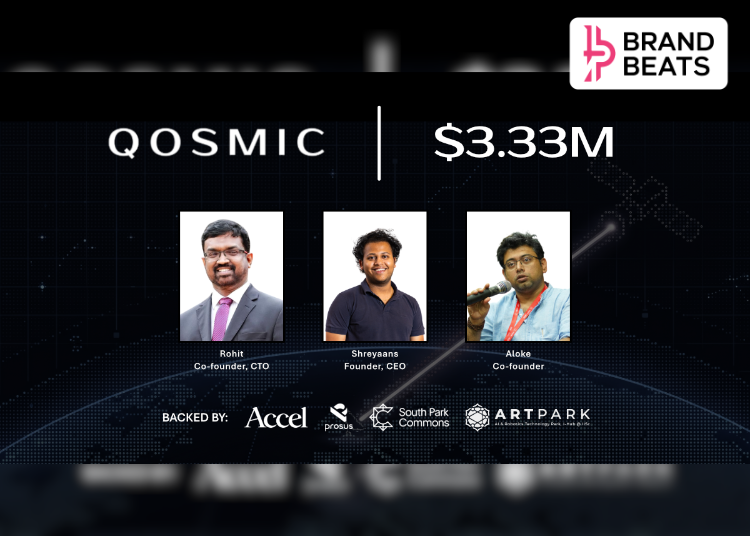
Bengaluru-based space technology startup QOSMIC has raised $3.33 million in seed funding in a round led by Accel and Prosus, with participation from South Park Commons, ARTPARK, and angel investor Manish Jain. The funding will support the company’s mission to build the optical communications backbone required for the next generation of the space economy.
Founded in 2025 by Shreyaans Jain, Rohit Ramakrishnan, and Prof. Aloke Kumar, QOSMIC is developing laser-based optical communication systems that enable satellites to transmit significantly larger volumes of data than conventional radio-frequency (RF) systems. The company is building both optical ground stations and satellite communication terminals, creating an end-to-end optical communications network.
The startup is targeting a growing challenge within the space industry. As satellites become increasingly sophisticated and generate massive amounts of data, existing radio-frequency communication systems are struggling to keep pace. Modern satellites can produce terabytes of information daily, but bandwidth limitations often prevent a significant portion of that data from being transmitted back to Earth.
QOSMIC believes optical communications can solve this bottleneck by replacing traditional radio links with laser-based systems capable of delivering substantially higher data transfer speeds and capacity. The company says it has already field-tested its complete optical communication stack over a 10-kilometre terrestrial link at Technology Readiness Level 6 (TRL6), demonstrating key capabilities including pointing, acquisition, tracking, and high-speed data transfer outside laboratory conditions.
The newly raised capital will be used to deploy operational optical ground stations and satellite terminals for international customers, expand manufacturing and testing capabilities, and strengthen the company’s engineering teams across optical, electronics, and mechanical disciplines.
The company’s founding story reflects a broader trend of Indian-origin deep-tech talent returning to build globally competitive technologies from India. Jain left a PhD programme in quantum computing in the United States, while Ramakrishnan returned after working on quantum communication payloads for satellite missions in Singapore. Prof. Kumar also returned from the US to join the Indian Institute of Science, bringing decades of research and engineering expertise to the venture.
QOSMIC says its systems have been designed to international interoperability standards, allowing seamless integration with satellite constellations, orbital data centres, and ground network operators worldwide.
Speaking on the funding, Shreyaans Jain, Co-founder and CEO, QOSMIC, said “The next decade of the space economy will be defined by data. Satellites are becoming exponentially more capable, but the infrastructure connecting them to Earth has not kept pace. We believe optical communications will become as fundamental to space infrastructure as fibre optics became to the internet. This funding enables us to accelerate that transition and build the connectivity layer that the next generation of space applications will rely on.”
“A decade ago, a company like this would have had to be built in the US or Europe. Today, India has the capital, the manufacturing depth, and the scientific institutions to build world-class space infrastructure. We came back because this is now the right place to build it, and we will not be the last founders to make that choice.” he added.
Commenting on the investment, Mahendran Balachandran and Pratik Agarwal, Partners at Accel, said “Satellites are collecting more than they can ever send back to Earth, and most of what they see never makes it down. As computing moves into orbit, that gap only widens. QOSMIC is solving it with laser ground stations that are faster, more secure and far cheaper than today’s systems. We’re proud to lead their seed round.”
Highlighting the significance of the technology, Prateek Mehta, General Partner at South Park Commons, said “The space economy of the future will only be as powerful as its ability to move data. Right now, that ability is broken. Satellites are generating terabytes every day, but not everything comes back because channels built for another era are completely choked. Laser-based optical communications is the way to unlock the bottleneck in space, and move data between orbit and Earth at speeds demanded by the next generation of applications.”
He further added “Shreyaans, Rohit, and Aloke are the team with the right mix of academic rigour, technical proficiency and entrepreneurial energy. From day minus one they have come at this problem with deep scientific rigour and ambition which is rare in the Indian ecosystem. Hence being the first investor in QOSMIC, when the product was still a vision, wasn’t a difficult decision. We can’t wait to see them build the connectivity layer the next generation in space runs on.”