

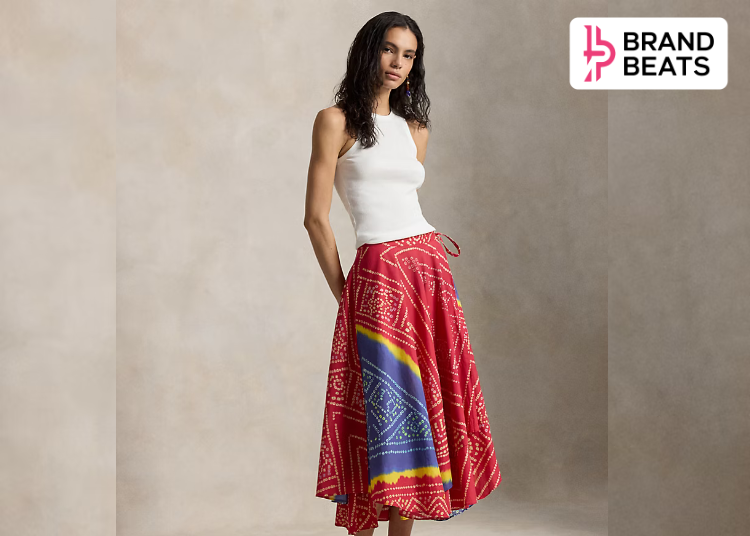
A pricing decision by Ralph Lauren has triggered a wider debate in India around fashion, cultural credit and global design practices, after a Bandhani-inspired skirt listed at around Rs 44,800 drew sharp reactions online.
The product, described as a printed cotton wrap skirt inspired by traditional Bandhani tie-dye techniques, quickly went viral. While the design referenced the craft, critics pointed out that it did not clearly acknowledge its Indian origins or the artisan communities associated with it.
Bandhani, a centuries-old textile technique from regions like Gujarat and Rajasthan, involves a detailed hand-tie and dye process that is both time-intensive and culturally significant. The controversy centres on the gap between this traditional craft and its interpretation in global fashion, especially when the original method is replaced by printed versions at premium price points.
At the time of filing this article, Ralph Lauren has not issued any official statement addressing the concerns around the Bandhani-inspired skirt or the reactions it has generated online.
The reaction online has been immediate and widespread. Social media users questioned both the pricing and the lack of clear attribution, with many calling it another example of global brands borrowing from Indian design traditions without adequate recognition.
This is how international fashion brands kiII Indian crafts. This is East India Company redux. @RalphLauren is selling this PRINTED bandhani skirt for a whopping 44,000 INR, without mentioning that it is Bandhani.
First of all, Bandhani or bandhej is a millennia old Indian tie… pic.twitter.com/stPuFS1Qq6
— Shefali Vaidya. 🇮🇳 (@ShefVaidya) April 21, 2026
Oh, didn’t you hear? Using a computer to copy-paste a 3,000-year-old heritage craft is the new “quiet luxury.”
Why support a master artisan who ties thousands of tiny knots by hand when you can pay a 900% markup for @RalphLauren to hit ‘Print’ on a polyester blend?
It’s not…— E.Bhaskar Rao (@DrEBhaskarrao) April 21, 2026
They sell blatantly because there are Indian companies who give them a platform. History repeats itself. It was native Indians who opened the doors for Mughals & British
And before people jump to random conclusions, do not mix this with FDI and global trade. This is stealing and…
— Sameer (@BesuraTaansane) April 21, 2026
₹44000 is what a true artisan making the genuine product would earn in a month. @RalphLauren has an unlimited capacity to put them out of business & may hire a few to work for peanuts. The rich in India would love showing off the brand name not caring about the art & artists’…
— Tushar Chandra (@tusharchan) April 21, 2026
It’s the responsibility of the Government of India to protect Indian traditions, culture and all connected uniquely with India.
That includes all the achievements of our ancestors.@PMOIndia it would be helpful if a committee were to be constituted to define what’s Indian.
— Anand Sharma (@sharma2508) April 22, 2026