

In 1969, Karsanbhai Patel was a chemist at the Gujarat Government’s Department of Mining and Geology. From a 10×10 ft room in his home in Ruppur, Gujarat, he produced a phosphate free synthetic detergent powder and sold around 15 to 20 packets daily to neighbours during his 15 km cycle commute to work.
Priced at just Rs 3.50 per kg, it was nearly four times cheaper than HUL’s Surf, which sold for Rs 13. That price difference was not a marketing tactic. It was the business model.
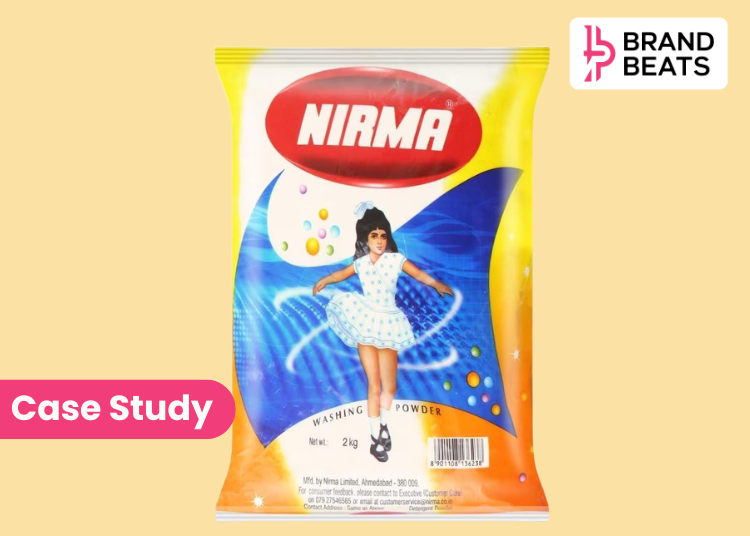
The first packaging featured a woman washing clothes, reflecting the product’s practical appeal. The now iconic girl in the white frock was introduced later with Nirma’s television advertising. Even then, the brand stayed true to its core promise of delivering value to price conscious consumers.
The story behind the girl in the white frock
Long before the girl in the white frock became one of India’s most recognisable advertising mascots, she represented someone deeply personal to Nirma’s founder. Karsanbhai Patel named the company after his daughter, ‘Nirupama’, affectionately called ‘Nirma’.
Tragically, she died in a road accident at a young age, years before the brand achieved national recognition.
When Nirma’s television campaigns took off in the late 1970s and early 1980s, the smiling girl in the white frock became the face of the brand. Paired with the iconic ‘Washing Powder Nirma’ jingle, the mascot quickly became one of the most recognisable symbols in Indian advertising.
Although the company never made the personal tragedy a part of its marketing, the mascot gave the brand a lasting identity rooted in its origins. Decades later, the girl in the white frock remains one of the most iconic brand characters in Indian advertising.
The cost machine: how Nirma made ‘cheap’ a competitive advantage
Unlike most FMCG companies, Nirma did not depend heavily on middlemen or third party manufacturers. Karsanbhai Patel believed that if the company wanted to keep prices low and compete with bigger brands like HUL, it had to control its own costs. That is why Nirma invested in making many of its own raw materials instead of buying them from suppliers.
In 2000, the company set up two large manufacturing plants.
The Baroda plant produced key ingredients used to make detergent, while the Bhavnagar plant manufactured soda ash, another important raw material. With these facilities, Nirma reduced its dependence on outside suppliers and lowered production costs.
Both plants were completed ahead of schedule and cost less than originally planned. The Baroda plant was built for Rs 2.5 billion instead of the estimated Rs 2.8 billion, while the Bhavnagar plant cost Rs 9.85 billion against a budget of Rs 10.36 billion. Despite its size, the Bhavnagar plant operated with only about 500 employees, compared to nearly 5,000 at a similar competitor’s facility.
Nirma also cut distribution costs by sending products directly from its factories to distributors. In the same year, it acquired Kisan Industries near Ahmedabad to bring printing and packaging under its own control. Over time, the company built a network of around 400 distributors and more than 2 million retail outlets, helping Nirma reach even the smallest villages across India.
Hiren K. Patel, CMD, Nirma Consumer Care, said, “Like other FMCGs, we have not concentrated only on marketing strategy. From the very beginning, operational strategy in cost containment, backward integration, economies of scale, innovative production, packaging and penetration schemes have received equal attention.”
The advertising campaigns: jingles, ballet dancers, and a brand that refused to demo
Nirma’s advertising history is inseparable from its brand identity. For three decades, the creative mandate sat entirely with Purnima Advertising Agency, which built the brand on a single, unshakeable communication axis: value-for-money, delivered aspirationally. The jingles, the imagery, the media choices all of it filtered through that lens.
Washing Powder Nirma (1975 to Present)
The iconic ‘Washing Powder Nirma’ jingle, featuring the line Dudh si safedi Nirma se aye, rangeen kapda bhi khil khil jaye, first aired on radio in 1975 and reached television in 1982. It went on to become one of the longest running FMCG advertising campaigns in India.
The dancing girl in the white frock became one of the country’s most recognisable brand symbols. Instead of selling luxury, the campaign focused on clean clothes, value for money, and the everyday Indian homemaker, making affordability itself aspirational.
The ‘Hema, Rekha, Jaya aur Sushma’
Released in the 1980s, the campaign featured the names of popular Indian women such as Hema, Rekha, Jaya, and Sushma, making it instantly relatable for households across the country. Combined with the iconic “Washing Powder Nirma, Doodh si safedi…” jingle and the girl in the white frock, it became one of the most memorable advertisements in Indian advertising history.
The ‘Mud-Stopping’
One of Nirma’s most memorable commercials from the 2000s showed a woman dramatically stopping a splash of muddy water in mid air to protect her white clothes. The ad stood out for its superhero style storytelling while reinforcing Nirma’s promise of superior whiteness and stain removal.
Category extensions: when the Nirma name ventured beyond detergent
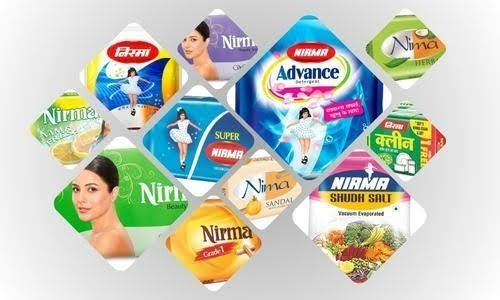
By the mid 1990s, Nirma began expanding beyond its flagship detergent by entering related product categories. Its strategy remained the same: offer products at affordable prices, use its strong distribution network, and leverage the trusted Nirma brand. This led to the launch of products such as Nirma Super Washing Powder, Nirma Detergent Cake, Nirma Premium, Nima Sandal, and Nirma Lime Fresh, covering both economy and premium segments.
By 1999, Nirma had captured a 15% share of India’s toilet soap market, becoming the country’s second largest soap manufacturer after HUL, which held 65%, while Godrej had 8%. In 2000, the company expanded further with products like Nirma Shikakai, Nirma Beauty Shampoo, and Nirma Toothpaste.
However, replicating its detergent success proved difficult. Unlike detergents, the soap and shampoo markets were driven more by brand image and consumer loyalty than price. While Nirma was trusted for affordability, convincing consumers to switch in these categories was a much bigger challenge.
The shampoo business presented a different challenge.
At the time, only about 30% of Indians used shampoo, and over 70% of them lived in cities. While Nirma had a strong rural distribution network, getting consumers to adopt shampoo instead of traditional hair care practices required changing habits, not just making the product available. As a result, the company’s success in detergents was difficult to replicate in the hair care market.
The rural equation: why Nirma never abandoned its heartland
During the 1990s and 2000s, many questioned whether Nirma’s core customers had moved on to more premium brands as their incomes and aspirations grew. However, the company maintained that rural India continued to be one of its strongest markets, contributing significantly to sales.
According to Manan Soni of Purnima Advertising, the gap between rural and urban consumers was becoming smaller as people migrated to cities and carried their buying preferences with them. As a result, Nirma created advertisements that appealed to both rural and urban audiences instead of focusing on either group
Nirma also built a strong distribution network across India. It operated depots in states such as Andhra Pradesh, Tamil Nadu, and southern Karnataka, while in states like Uttar Pradesh and Madhya Pradesh, products were shipped directly from factories to distributors. With more than 2 million retail outlets, especially in Tier 3 and Tier 4 markets, Nirma’s extensive distribution network remained one of its biggest competitive strengths.
The conglomerate pivot: from washing powder to cement and pharmaceuticals
From selling detergent on a bicycle, Nirma has grown into one of India’s leading mid sized conglomerates. Its diversification gathered pace in 2007 with the acquisition of US based Searles Valley Minerals Inc., making it one of the world’s top seven soda ash manufacturers.
The company entered the cement business in 2014 by establishing Nuvoco Vistas Corporation and commissioning its Nimbol plant, before strengthening its presence through the US$1.4 billion acquisition of Lafarge India’s cement assets in 2016 and the Rs 5,500 crore acquisition of Emami Cement in 2020.
In 2023, Nirma expanded into pharmaceuticals by acquiring a 75% stake in Glenmark Life Sciences for Rs 5,652 crore. The company was renamed Alivus Life Sciences in 2024.
The pharmaceutical play, acquiring Glenmark Life Sciences for $680 million in 2023, marked Nirma’s most ambitious diversification yet, taking it into active pharmaceutical ingredient (API) manufacturing through what is now Alivus Life Sciences. Whether these moves reflect a coherent operating strategy or simply the capital allocation choices of a family owned cash machine remains debated.
What is clear, however, is that Karsanbhai Patel’s instinct for spotting undervalued opportunities, first seen when Nirma was priced at Rs 3.50 against Surf’s Rs 13, has extended well beyond the laundry aisle.
What Nirma actually proved
Nirma’s success was not just about offering a lower priced detergent. It created a large mass market segment that established players had largely overlooked and scaled it rapidly before competitors responded. The business later used the cash flows generated from its detergent operations to invest in manufacturing, expand its distribution network, and diversify into new industries.
Advertising played a central role in this growth. The iconic Nirma jingle, first aired on radio in 1975 and on television in 1982, helped make the brand a household name across India.
Sumanto Chattopadhyay, Executive Creative Director at O&M, said, “When it first came, Nirma shook its competitors and the Nirma girl stole every housewife’s heart. As of today, I believe, they are at a crossroads, and so they need to reinvent themselves, because the market itself has become much more evolved.”
BrandBeats’ Take
Nirma’s biggest innovation was not a detergent. It was a business model. By combining relentless cost control, backward integration, mass distribution, and memorable advertising, the company built a market that incumbents had ignored. The lesson for brands is clear: lasting disruption comes from aligning pricing, operations, distribution, and branding behind a single value proposition, not from competing on price alone.
FAQs
- Who founded Nirma?
Nirma was founded by Karsanbhai Patel in 1969. He started by making detergent powder at home and selling it door to door while working as a government chemist.
- Why is the Nirma jingle so famous?
The ‘Washing Powder Nirma’ jingle became one of India’s longest running and most recognizable advertising campaigns. It helped build strong brand recall across generations.
- What made Nirma different from other detergent brands?
Nirma focused on keeping costs low through backward integration, efficient manufacturing, and a strong distribution network while offering affordable products to consumers.
- Does Nirma only make detergents?
No. Over the years, Nirma expanded into soaps, shampoos, cement, chemicals, and pharmaceuticals, becoming a diversified business group.