

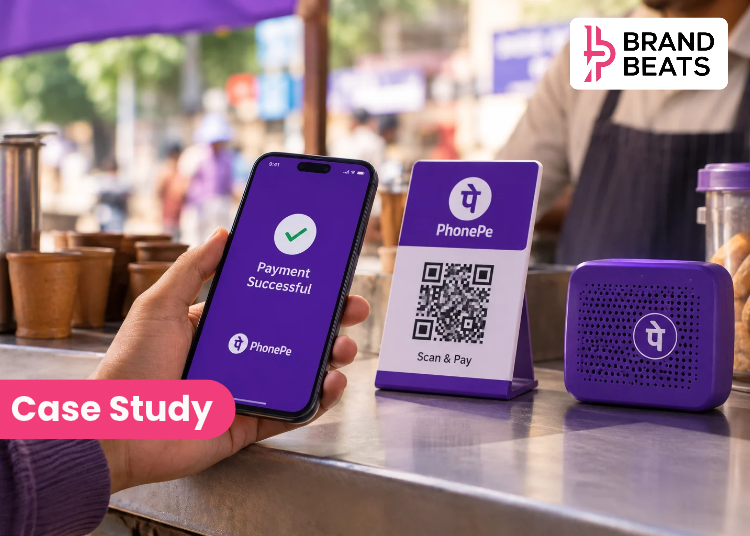
Every day, millions of Indians finish a purchase the same way: scan, pay, wait for the confirmation. A cup of chai at a roadside stall, a bag of vegetables, an auto fare. For half a second, the whole transaction rests on a small purple square and a short sound.
That moment is where PhonePe lives.
PhonePe did not invent digital payments. UPI, the rail every rival app runs on, was built by NPCI, and the core job of sending money or scanning a QR code looks much the same from one app to the next. Yet by December 2025, PhonePe was handling about 45% of all UPI transactions by volume, according to NPCI data reported by Reuters. By April 2026 it had crossed 70 crore registered users, and it now counts more than 5 crore registered merchants.
So how does a brand stand out when the product, the infrastructure and even the QR code can be matched by a competitor? PhonePe’s answer was to build an identity that could be recognised and trusted in India’s hardest conditions: a sticker fading in the sun, a counter too noisy to hear a phone buzz, a budget phone with a weak speaker.
This case study follows that journey: a failed music start-up, a one-week head start on UPI, an IPL-led marketing push with Aamir Khan and Alia Bhatt, a 2021 identity redesign that began with a purple that would not stay purple, a SmartSpeaker that gave the brand a voice, and an October 2026 rename that tests how far the PhonePe name can stretch.
The larger marketing question is a sharp one: in a category where the product is a commodity, can a brand win by being the most dependable presence in a customer’s everyday moment, rather than the loudest voice in the ad break?
The Origin: A failed music start-up and a one-week head start
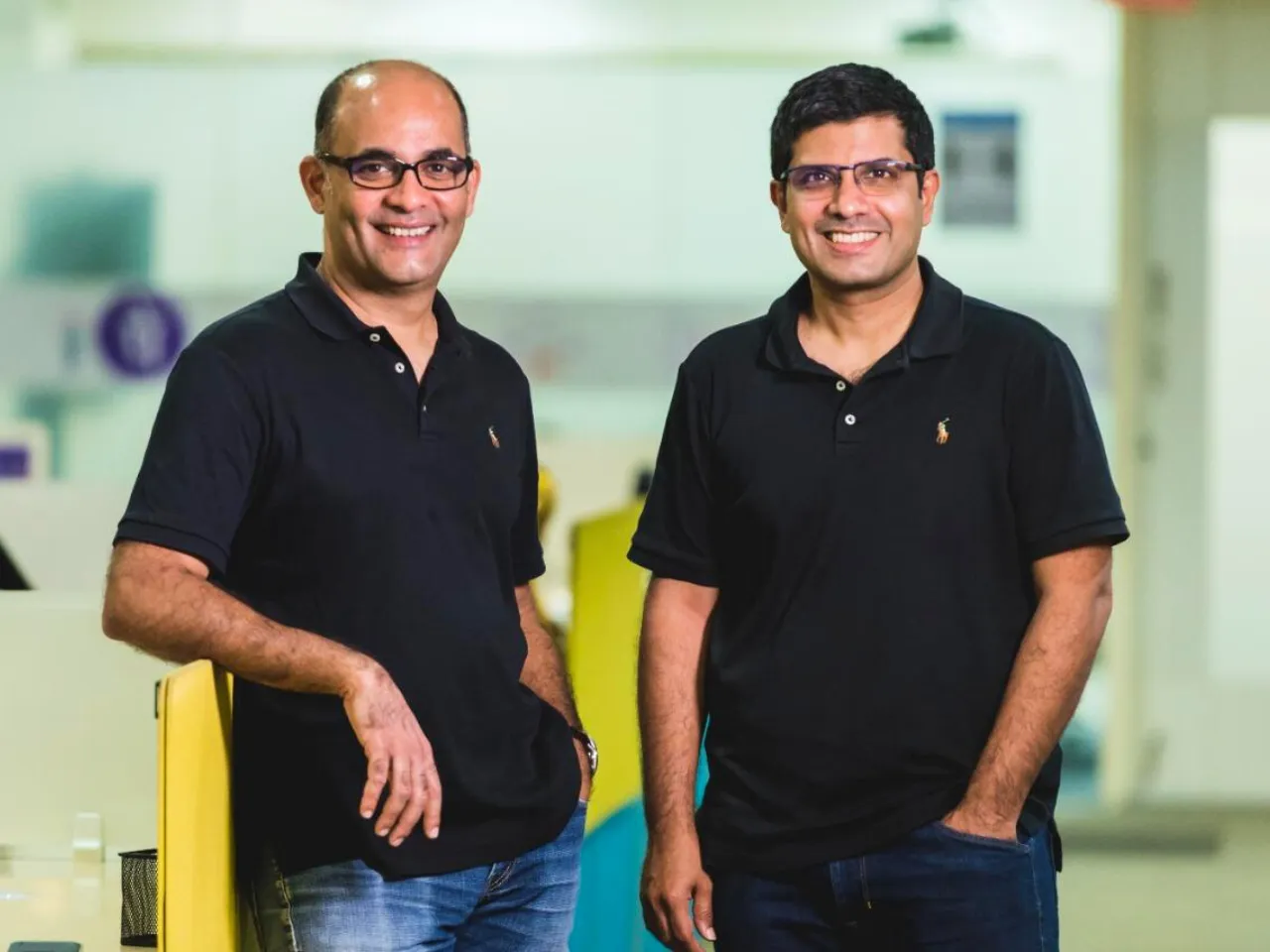
PhonePe’s story begins with a product that did not work. In 2012, Sameer Nigam and Rahul Chari, both then at Flipkart, launched Flyte, a music-download platform. Nigam later said the pair learned the hard way that music is not an easy business to make money in, as YourStory reported.
The detour turned out to be useful. Nigam and Chari had been friends and roommates at the University of Mumbai in the 1990s, according to Contrary Research, and they went back to building Flipkart’s infrastructure. Together with Burzin Engineer, they founded PhonePe in December 2015. Their thinking drew on earlier work with big banks on IMPS, a brokering layer that Nigam has said UPI itself eventually became. Confidence from the RBI and NPCI in UPI convinced them to place the bet.
Timing did the rest. UPI launched commercially in August 2016, and PhonePe had its app out within a week, as The Ken reported. Flipkart had acquired the company that April, nearly five months after it was incorporated, reportedly for less than $20 million. Flipkart ownership also gave the young app early exposure to online merchants.
Then came November 2016. Demonetisation turned digital payments from a convenience into a necessity almost overnight. PhonePe recorded 1.1 million transactions in December 2016, according to The Ken.
By August 2017 it had overtaken the government’s own BHIM app on UPI transactions, and by January 2018 the app had been downloaded 10 million times, per Wikipedia.
Early growth leaned on distribution, not advertising. By late 2019, PhonePe reported 170 million registered users and 7.8 million merchants across 215 cities, with roughly 55% of its transactions coming from outside the top-tier metros, according to Business Insider India. A company executive told the publication that PhonePe was also the first to introduce an interoperable QR code, letting small merchants accept payments at zero merchant fees.
That ‘Bharat’ footprint was PhonePe’s biggest strength. It also set up its next problem: a very large and very diverse customer base that used the app a lot but did not feel strongly about the brand.
The Challenge: Winning in a market where every app does the same job
UPI is an open system. Any bank account can be linked to any app, switching costs are close to zero, and a shopkeeper can display several QR codes side by side. A payments brand cannot rely on exclusivity, so it has to earn habit.
And the field filled up fast. Paytm had built a large wallet user base during demonetisation. The government pushed its own BHIM app. In September 2017 Google launched Tez, later renamed Google Pay, to heavy anticipation, and it leaned on cashback to win users, as Inc42 and TechRadar reported at the time. An official quoted by Inc42 even noted that transaction volumes tend to pick up whenever apps offer incentives.
The contest was tight. According to The Ken, Google Pay passed PhonePe to become India’s biggest UPI app in 2019. PhonePe moved back ahead in December 2020, per Entrackr. By March 2021 it had become the first platform to cross a billion UPI transactions in a month, and in May 2021 its 1.14 billion transactions meant a 47.7% share of UPI.
But the numbers hid a brand problem. In 2019 the founders hired Richa Sharma, a Vodafone and Flipkart marketing veteran, to define the brand. She began with a pan-India study of customers and merchants. The finding was blunt: people liked how the app performed, but their perception of PhonePe was diffused and there was no strong association with it.
That is a risky place to be for a market leader. If customers could not say what PhonePe stood for, a rival with a bigger discount or a bigger parent could take its place. The task was no longer just to add users. It was to give the brand something to mean.

The Strategy: A brand for every Indian, built on small steps
The usual rule of brand strategy is to define your audience tightly. PhonePe could not. Every Indian with a smartphone and a bank account was a customer or a prospect.
Sharma chose to treat that as a strength rather than a headache. Addressing people across cities, incomes and ages, she said, was the defining code of PhonePe’s communication. Her team identified nine customer personas, plotted on two axes: digital sophistication and financial sophistication. At one end sat a teenager who was active online but not financially independent. At the other sat someone financially savvy but nervous about technology.
What connected all nine was the wish for a better life. Whether people wanted to live better today or invest for tomorrow, money was part of how they hoped to move up.
That insight shaped the brand platform:
- Audience: every Indian who wants to upgrade their life, across nine personas.
- Positioning: PhonePe as a bridge to progress for a billion Indians who work hard every day to realise their aspirations.
- Expression: ‘Karte Ja, Badhte Ja’, roughly ‘keep doing, keep moving forward’. Progress comes through small, steady steps, hard work and resilience.
- Role of marketing: a two-step job, first answering ‘why should I do this online?’ and then ‘why should I do it with PhonePe?’

The Marketing Playbook: IPL, Aamir Khan and a purple takeover
With the platform defined, PhonePe needed a stage big enough to introduce digital payments to people who had not yet tried them. It chose the IPL.
PhonePe was a co-presenting sponsor of the IPL broadcast for three years running by 2021. Its logic, was that the association gave PhonePe visibility, high brand recall and a way to build awareness of digital payments across user segments.
The same report noted that IPL’s shorter ad breaks make it a natural fit for tightly built campaigns. Nigam described the IPL as the perfect platform to bring digital payments to a billion Indians, in an interview with IMPACT.
One idea made the brand colour the hero: a ‘Purple Day’, a one-day takeover of the Star Sports network to build awareness of the app.
The Aamir Khan and Alia Bhatt campaign. In February 2020, It was reported that PhonePe had earmarked Rs 800 crore for marketing as it launched a five-week brand campaign around the line ‘Karte Ja, Badhte Ja’, with four TV commercials starring Aamir Khan and Alia Bhatt.
During IPL 13, agency Leo Burnett followed with a nine-film series in which a tech-savvy Alia Bhatt slowly converts a sceptical Aamir Khan, in a cop-themed storyline, to show how easily digital payments fit into daily life. The films did not use cricket themes, the aim was to entertain viewers and stand out during the breaks. The series, shot under lockdown restrictions, collected 425 million views across social platforms.
The pandemic film. As India reopened, a brand film voiced by Aamir Khan celebrated people moving ahead despite COVID-19, using the line ‘Rukna toh humein aata nahin’ (‘we don’t know how to stop’). It ran as a 1 minute 50 second master film plus five 15-second stories, and the company said it then served over 20 crore users and over 1 crore merchants, per Indian Television.
‘Har Phone Pe PhonePe Hai’. To celebrate its market leadership, PhonePe then dropped conventional storytelling for a film that mixed video-game graphics, quirky illustrations and stop motion, nodding to cultural moments of 2020 such as the ‘Rasode mein kaun tha?’ meme. Sharma said the team wanted to break away from conventional storytelling formats.
IPL 2021, the biggest push yet. In March 2021 PhonePe took six sponsorships at once: co-presenting sponsor on Star Sports, associate sponsor on Disney+ Hotstar, and partner of four franchises (Mumbai Indians, Chennai Super Kings, Royal Challengers Bangalore and Delhi Capitals). Nigam called it the company’s most aggressive national marketing campaign ever. The stated goals were to grow the user base from 280 million to 500 million by December 2022, and to build affinity among people who had never tried digital payments while driving preference among those who had.
Beyond Payments: Advertising a financial supermarket
By 2021, PhonePe was no longer only a payments app. It had added mutual funds, gold and insurance, among other services, and each product needed its own marketing job. The brand now had to teach people why they should buy a financial product on a payments app at all.
Language got serious attention too. When 82.5 Communications won the mandate to take ‘Tension Chhodo, Insurance Lo’ to five South Indian states in January 2022, it did not dub the Hindi film. It shot a separate version for each state, which the agency described as a language-first approach.
| Product | Campaign | The idea |
| Insurance | ‘Tension Chhodo, Insurance Lo’ (South India, 82.5 Communications) | Region-specific films shot separately for five states instead of dubbed ads |
| Insurance | Six-month brand campaign with Aamir Khan and Alia Bhatt | Sell calm instead of fear |
| Motor insurance | ‘Insurance Your Way’ | Five films on transparency, no unwanted calls, optional add-ons |
| Gold | TV campaign for gold | Storylines and actors customised for different audiences to show digital gold is easy and safe |
| Everyday payments | Nine dialogue-free IPL films (The Script Room, Nirvana Films) | Informal and tiny payments: paying for ironed clothes, a single-digit payment, a car insurance renewal before handing over the keys |
| Health insurance | Three-film campaign (The Script Room, Early Man Films) | Exaggerated humour on the cost of being uninsured, with a monthly premium option |
The pattern is worth noticing. PhonePe rarely sold features. It sold the removal of friction, whether that was fear, unwanted calls, or the worry that small payments don’t count.
The Brand Refresh Of PhonePe
The brand idea was set, but the visual identity had not kept up. According to media reports, PhonePe’s original identity had grown organically and intuitively with a fast-scaling business, and it amounted to little more than a logo and a purple. Now the brand had to appear everywhere, from a life insurance purchase to a utility bill to a sticker at a tea stall.
PhonePe worked with Gurgaon-based design studio Codesign, and the project was written up in mid-2021.
The common ground was ‘Karte Ja, Badhte Ja’. The differences were the hard part. The identity had to flex across very different contexts, and it had to hold up on every kind of device, from basic smartphones to top-end models. Every asset, from logo to colour to sound, was evaluated and fine-tuned across that spectrum.

The Sound of Trust: How a small speaker gave PhonePe a voice
For a street vendor, the important question after a customer scans the QR code is not whether the customer paid. It is whether the money has arrived. Before PhonePe’s SmartSpeaker, merchants using feature phones relied heavily on SMS alerts, as Storyboard18 noted.
PhonePe launched the SmartSpeaker in August 2022 to give offline merchants voice-based payment confirmation. The first release covered eight cities with over 1 lakh devices in use, alerts in 11 languages, a battery of up to four days, and doorstep installation for an initial Rs 50 plus a low monthly rental, according to the company. By November 2022, only three months after launch, it had deployed over 10 lakh devices, which had handled more than 100 crore transactions.

What made PhonePe’s brand different from a typical fintech campaign?
The strength of PhonePe’s brand was not a single ad. Plenty of fintechs buy IPL inventory and sign film stars. What stood out was how closely the idea, the design and the product agreed with each other.

- It turned a commodity into a promise of progress. UPI payments are interchangeable, so PhonePe gave each transaction a meaning: another small step forward. That one idea carried the ads, the identity and the internal brand work.
- It designed for the hardest conditions, not the best. The purple was adjusted because stickers fade in Indian sunlight. The confirmation sound was re-engineered for noisy counters and weak phone speakers. The brand was built for the kirana, not the keynote.
- It tested the brand in the field. Logo sizes were compared in the same shop against real app-usage data, and rollout included audits and feedback from ground teams, so the identity could survive implementation.
- It gave the brand a voice. A sonic logo, a re-engineered alert and a SmartSpeaker with celebrity voices turned a payment confirmation into a branded moment, heard every time a payment lands.
- It localised instead of translating. Insurance films were shot separately for five southern states, and the speaker offered regional voices such as Mammootty, Kichcha Sudeep and Mahesh Babu in their home markets.
- It showed its data. PhonePe Pulse, an open data platform of payment trends down to PIN-code level, per a newsletter account by Insight Forge, positions PhonePe as a source of insight about India’s digital economy, not only a payments app.
The Takeaway: Build the brand for the counter, not the keynote
PhonePe is a useful case study because its product could not be made different, so its brand had to be built where products usually are not: in the sun, in the noise and in the language of the person at the counter.
The brand took one simple belief, that progress comes in small steps, and carried it through everything. Advertising made digital payment feel ordinary and aspirational. The identity was redrawn after merchants noticed their stickers fading. A sound was engineered to cut through a crowded shop. A speaker announced each payment in a voice the shopkeeper trusted.
The progression matters. The brand did not stay inside the ad break. It moved into the app, onto the QR stand and into the shop’s soundscape, which is where customers decide whether to trust a payment.
The open question is what comes next. A name built on small payments is now being asked to carry savings, insurance and investing, and its IPO is still on hold. PhonePe Invest and the market’s response to it will show how far that trust can stretch. What the brand has already shown is that trust is not what a payments company says about itself. It is what happens, every day, in the half-second after someone pays.